PRESTO PLANS






Sent straight to your inbox
CLICK HERE TO ACCESS
Sign up to receive 10 ready-to-use ELA resources your students will love!
10 FREE ELA RESOURCES








6 St. Patrick’s Day Activities For Middle School ELA
St. Patrick’s Day is just around the corner, and there are more ways to celebrate than by just wearing green and shamrocks! For English Language Arts teachers, St Patrick’s Day presents the perfect opportunity for building classroom community while developing students’ ELA skills at the same time. Here are 4 holiday activities you can use in your ELA classroom this year.
1. The History of St. Patrick’s Day
Despite the fact that St. Patrick’s Day is celebrated all around the world, many of us know relatively little about the history of this holiday. For example, did you know that the first St. Patrick’s Day parade occurred when Irish soldiers in the British army marched through New York City on March 17, 1762?
I love to use this time of year to introduce students to St. Patrick’s Day history. You can teach them the significance of the symbols we see around this time of year, such as the shamrock, the four-leaf clover, the Celtic cross, and the leprechaun. You can also explain some of the traditions, like how the Chicago River has been dyed green in celebration of the holiday every year since 1962.
After giving an introduction on St. Patrick’s Day history, I then provide writing prompts related to the history they’ve just learned, and I get them to write their responses on journal response sheets. Here is a couple of writing prompts you might use:
-
“If you caught a leprechaun, how would you spend the gold that he would be forced to give you?”
- “If you found a 4-leaf clover, what would be your idea of a day with perfect luck?”

2. St. Patrick’s Day Figurative Language
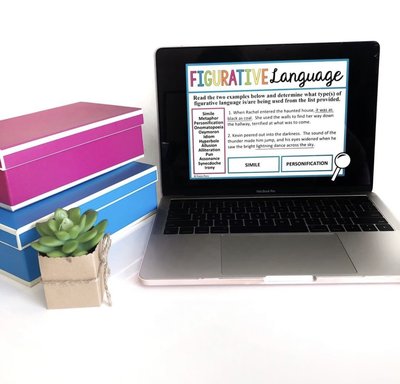
Saint Patrick’s Day is also the perfect time to cover common literary devices used in poetry and fiction. Develop your students’ understanding of metaphor, simile, onomatopoeia, oxymoron, personification, and alliteration with St. Patrick’s Day figurative language examples.
For this activity, you can put together various St. Patrick’s Day-related sentences that each employ one of the common literary devices mentioned above. Your students will need to identify which type of figurative language is being used on the line beside each sentence. I like to make this a competition where students can work in pairs and the first three pairs to get all sentences labeled receive a gold chocolate coin.
Here are a few St. Patrick’s Day figurative language examples you can use with your class:
- “The Chicago River, dyed green every year for St. Patrick’s Day, swallowed the earth as the green water rose higher and higher.” (Personification)
- “The leprechaun clinked his hammer against the shoes he was making.” (Onomatopoeia)
- “Good fortune favored him when he found a four-leaf clover.” (Alliteration)

3. How to Catch a Leprechaun Writing Activity
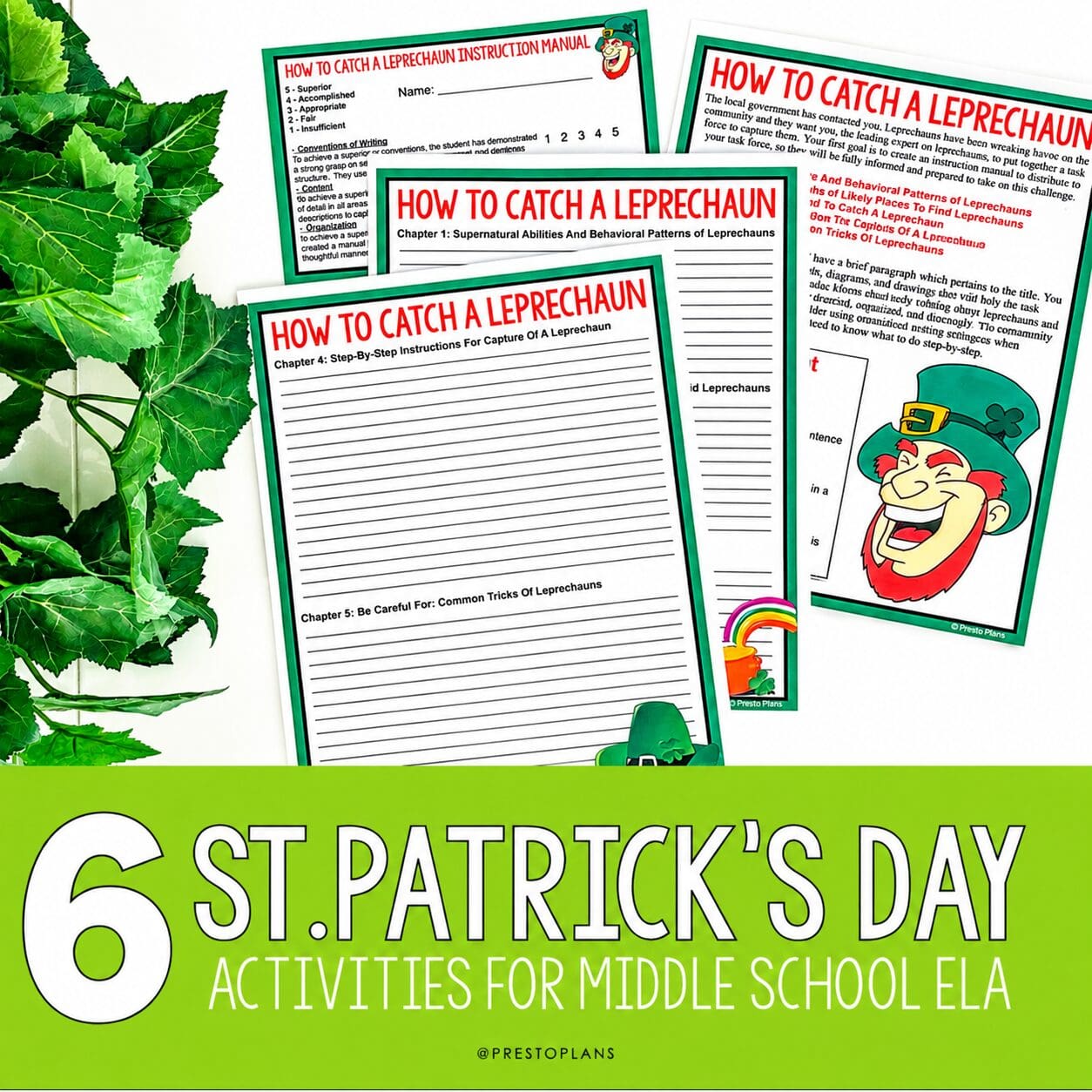
Have students assume the roles of leading experts on leprechauns and use instructional writing to share the best way to catch a leprechaun. Students will write a manual for the group tasked with catching leprechauns wreaking havoc on a local community.
You can start by telling students that have been contacted by the local government. Explain that they have to put together a team to tackle the issue head-on. First, however, they must use their expert knowledge on the subject to create an instruction manual to distribute to their task force so that they will be ready for the challenge.
Below are the topics that I have my students cover in their manuals on how to catch a leprechaun. I like to get students to organize each of them as distinct chapters, numbered as such:
- Supernatural Abilities And Behavioral Patterns of Leprechauns
- Locations – Descriptions of Likely Places To Find Leprechauns
- Essential Items Needed To Catch A Leprechaun
- Step-By-Step Instructions For Capture Of A Leprechaun
- Be Careful For – Common Tricks Of Leprechauns
I also like to provide students with the grading rubric I use to assess their writing before they begin to let them know exactly what is expected. I focus on the conventions of writing, content, and organization.

4. St. Patrick’s Day Trivia Game
Bring in a St Patrick’s Day-inspired ELA classroom game. Using a St. Patrick’s Day trivia game is a fantastic way to not only build classroom community this March 17 but also to learn more about the holiday. Students will be competing to be named the St. Patrick’s Day expert by correctly answering 10 trivia questions related to the holiday. Here’s how it works.
You will start by giving each student a St. Patrick’s Day trivia card. This is where students will track their answers to the ten questions. For each question, students will be shown four possible answers in multiple-choice format—with only one of them being correct. For each correct answer, students will move up the ladder shown on the right-hand side of each trivia card which ranges from “Piece of cake!” to “Expert” status.
Students will track their own individual scores, and then whoever has the most correct answers at the end wins and is given a cheesy St. Patrick’s Day expert winners certificate. You might choose to put the students into teams instead and have them come up to the front of the room and play against each other one on one.

5. St. Patrick’s Reading Mystery
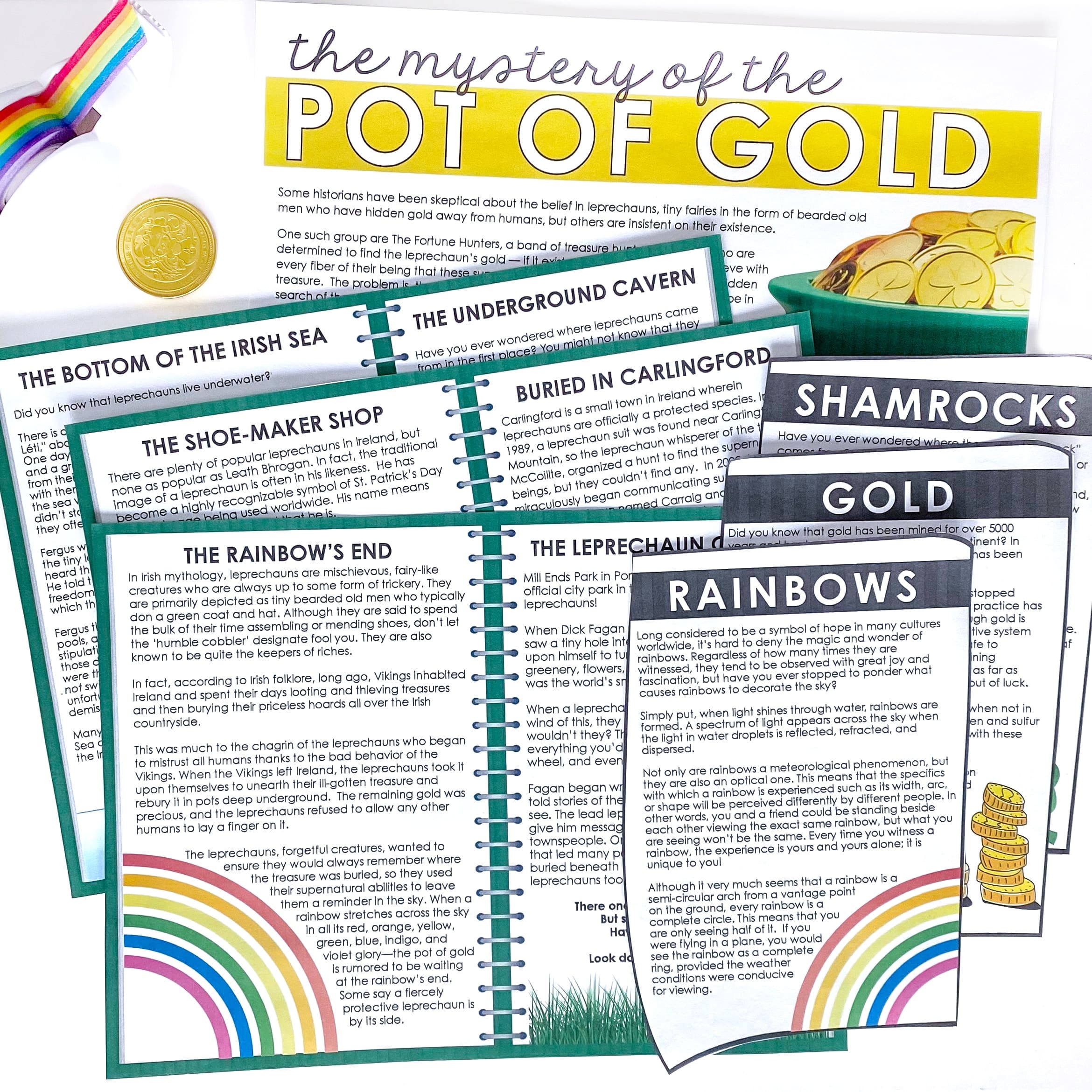
If you’re looking for a fun way to get your students practicing their close reading and inference skills this St. Patrick’s Day, why not have them solve a mystery? With the St. Patrick’s Day Reading Mystery, students will work together to uncover the secret location of a leprechaun’s missing pot of gold!
The activity begins with a group of treasure hunters in Ireland known as the Fortune Hunters. When their leader, Saoirse Murphy, discovers a perfectly preserved gold coin, she believes they may finally be on the trail of something magical. Now, your students must examine the clues and help determine where the leprechaun’s gold is hidden.
I like to start this activity by displaying a mystery poster on my classroom door to get students curious before they even enter the room. Then, I divide students into small groups and use the presentation slides to introduce the backstory and explain the mystery they will be solving.
Each group receives a collection of clues and evidence, including different leprechaun myths and information sheets. Students must read each text closely, make inferences, and use a graphic organizer to track evidence that supports or rules out the different possible locations of the gold.
Once each group has made their final prediction, I use the presentation slides to reveal the correct location and walk students through the evidence. I love this activity because students get so caught up in solving the mystery that they don’t even realize how much close reading and critical thinking they’re doing along the way!
6. Pot of Gold Collaborative Writing Activity
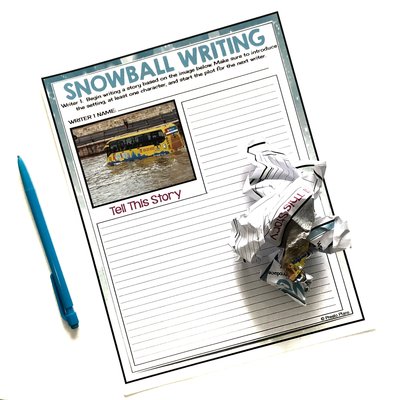
The final St. Patrick’s Day activity is one of my favorite ways to get students moving, collaborating, and practicing their creative writing skills! With the Pot of Gold Collaborative Writing Activity, students work together to create a story with a fun St. Patrick’s Day twist. The best part? They get to crumple up their writing and toss it across the classroom!
To begin, I hand out writing worksheets featuring different St. Patrick’s Day-inspired picture prompts. Students use these images as inspiration to begin writing a narrative, introducing the setting and characters. After a set amount of time, I tell students to crumple up their papers into little balls of “gold” and toss them toward a rainbow displayed at the front of the classroom.
Next, students head to the front of the room, collect a new piece of “gold,” and unfold it to discover the story someone else has started. Their job is to continue the narrative, developing the plot and introducing a conflict. After another round of writing, students crumple their papers again and toss them back toward the rainbow for one final exchange.
During the last round, students must bring the story they’ve received to a satisfying conclusion. Once all three rounds are complete, the stories are returned to their original authors, who revise and edit their collaborative narratives into polished final copies.
Students always have so much fun with this activity, especially when they realize they’re actually allowed to crumple up their writing! For an extra festive touch, I recommend printing the worksheets on yellow paper so that the crumpled pages look like little pieces of gold. It’s a great way to bring some movement and excitement into your classroom while still giving students meaningful practice with setting, character development, plot, and conflict.
I hope you have fun with these engaging St Patrick’s Day activities in your ELA classroom this year. You can grab a ready-to-use bundle with all of the resources and more by clicking the image below.

For more classroom community-building tips and resources, click here.
Search the blog for what you are teaching



GIVEAWAYS
sent straight to your inbox!


share this post