PRESTO PLANS





Sent straight to your inbox
CLICK HERE TO ACCESS
Sign up to receive 10 ready-to-use ELA resources your students will love!
10 FREE ELA RESOURCES








8 Creative Activities to Teach Number the Stars by Lois Lowry
One of my favorite books to teach in middle school ELA is Number the Stars by Lois Lowry. This novel, first published in 1989, won both the Newberry Medal and National Jewish Book Award (in the Children’s Literature category) for its moving and accessible portrayal of the Holocaust for younger readers.
Number The Stars tells the story of ten-year-old Annemarie Johansen, who lives in Copenhagen with her family during the Nazi occupation of Denmark. When the Germans announce their plans to “relocate” Denmark’s Jewish population, the Johansen family takes in Annemarie’s best friend, Ellen Rosen. Working as part of the Danish Resistance, Annemarie’s family helps Ellen and her parents as they attempt to flee to safety in neutral Sweden.
If you’re considering Number the Stars for your next middle school novel study, I’ve rounded up a selection of creative activities to help you teach Lois Lowry’s moving and meaningful book.
1. King Christian Historical Context
When I teach any historical novel, I think it’s important to ensure that students have relevant background information before they begin reading. Because Number the Stars largely takes place in Copenhagen in 1943, I like to spend some time sharing more information about King Christian X of Denmark. During the German occupation of Denmark, King Christian became a powerful symbol of Danish resistance, and his reign – which lasted until his death in 1947 – was characterized by his courage and resilience in the face of unthinkable adversity.
I like to begin by sharing a brief, one-page nonfiction article about the life and achievements of King Christian X, specifically highlighting the period between 1940 and 1945, where Denmark was under German occupation. Once students have read the article, they must respond to a series of questions about King Christian X, providing specific evidence to support their thoughts and ideas.
Sometimes, I prefer to have students complete this reading before they begin the novel. This task would also be appropriate to pair with Chapter 2 of Number the Stars, which is titled “Who is the Man Who Rides Past?”
TEACHING TIP: If you prefer to have students read about King Christian X before beginning Number the Stars, you may wish to have them save the final question until they have completed Chapter 2.

2. Jewish New Year Web Quest
Chapter 4 of Number the Stars by Lois Lowry takes place on the day of the Jewish New Year. I find that guided research tasks can help students explore and understand more about cultural and religious practices – especially if these traditions are unfamiliar to some students. Before I teach Chapter 4 of Number the Stars, I like to send students on a “WebQuest” to learn more about the Jewish New Year. Working alone, with a partner, or in a small group, students must first carry out basic research to learn more about terminology associated with the Jewish New year. Next, they view a brief video and respond to questions about how Rosh Hashanah is traditionally celebrated. To wrap up, I like to invite students to write a reflective paragraph considering the actions and events of the past year, and to set intentions for the year to come.

3. Constellation Connection
In Chapter 10 of Number the Stars, Annemarie’s brother-in-law Peter reads a psalm as the family hosts a traditional “funeral” in their home for the mysterious Great-Aunt Birte – and narrowly avoids detection by the authorities. Peter makes reference to the Lord, “who numbered the stars one by one.” As Annemarie reflects on the meaning of the psalm. She considers the size of the sky, and the impossible task of numbering all the stars within it.
When I teach this section of Number the Stars, I like to encourage students to think creatively about one theme, symbol, or moment from the novel so far, and consider how it could be represented as a constellation. Using a template, students can design their own visual in the style of a constellation. Then, on the back of the page, I invite them to provide a brief paragraph explaining the inspiration behind their creative design.

4. Character Diary Entry
As the action begins to build in Number the Stars, I like to spend some time teaching students about character analysis. By the time students complete Chapter 12, they likely have a strong understanding of several characters, including Peter, Ellen, Mrs. Rosen, and Uncle Henrik.
At this point in the novel, I like to introduce a creative writing task. Students begin by selecting one of these four characters and consider what this person might write in a private diary entry. As they organize their ideas, I remind them that because diaries are personal, this is a place where their character can express their innermost thoughts!

5. Postcard in Code
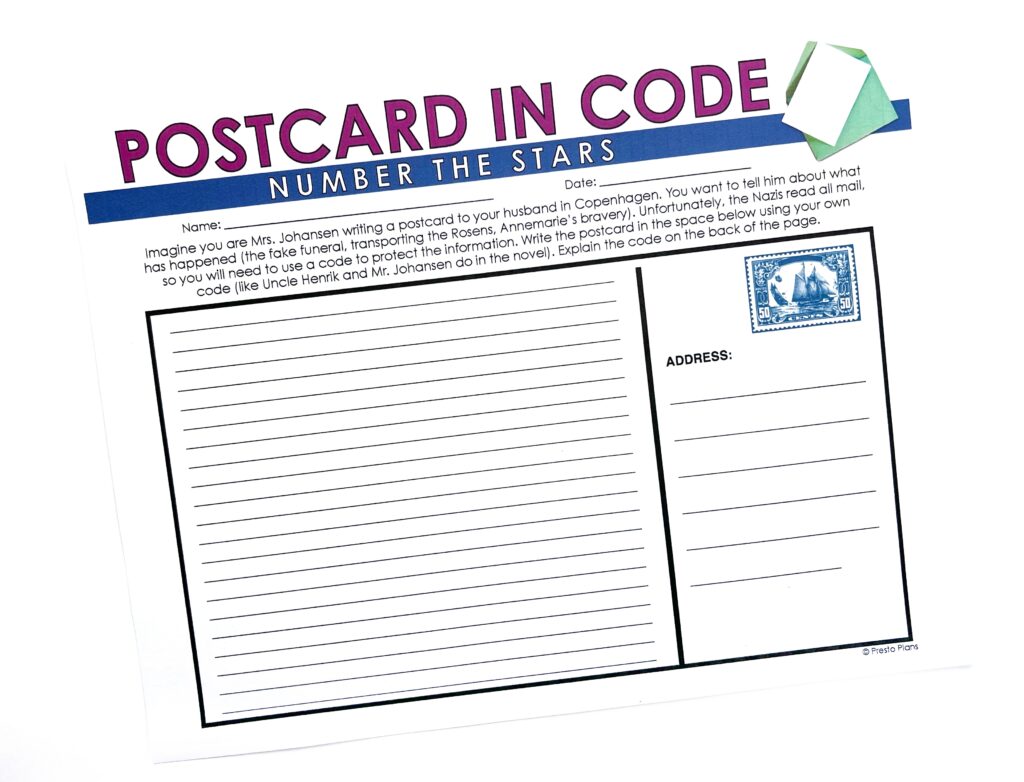
As I teach Number the Stars by Lois Lowry, I like to draw students’ attention to the various deceptions – such as the “funeral” of Annemarie’s fictional great-aunt, as well as the coded conversations between Peter and Uncle Henrik – used by the Danish Resistance to evade detection.
In the Postcard In Code activity, students step into character as Mrs. Johansen, who wishes to write a postcard to her husband in Copenhagen. Because the Nazis read all mail, the postcard must be written in “code” to ensure the Johansens remain undetected. I suggest that students might include encoded information about transporting the Rosens out of Denmark or Annemarie’s bravery. Once students complete their postcard, they must also explain how they concealed the message with code and how Mr. Johansen could decipher its true meaning.
6. Little Red Riding Hood Comparison
When Annemarie races to Uncle Henrik’s boat with Peter’s parcel concealed in a packed lunch, she comforts herself by recounting the story of “Little Red Riding Hood” – one of her little sister’s favorite fairy tales. When I teach this section of Number the Stars, I invite students to compare and contrast the characters, plot, tone, and setting of this section of the book with the classic fairy tale. They can use Annemarie’s version of “Little Red Riding Hood” from Chapter 14 of the novel, but if time allows, I like to spend a few minutes reading the traditional story to the class.
From here, students can work alone, in pairs, or in a small group to jot down the similarities and differences between the two texts. A graphic organizer can help them keep track of their initial ideas. To wrap up, I like to bring the class into a whole-group discussion about their comparisons. Alternatively, students can share their thoughts in “jigsaw”-style small groups.

7. The Free Danes Newspaper Project
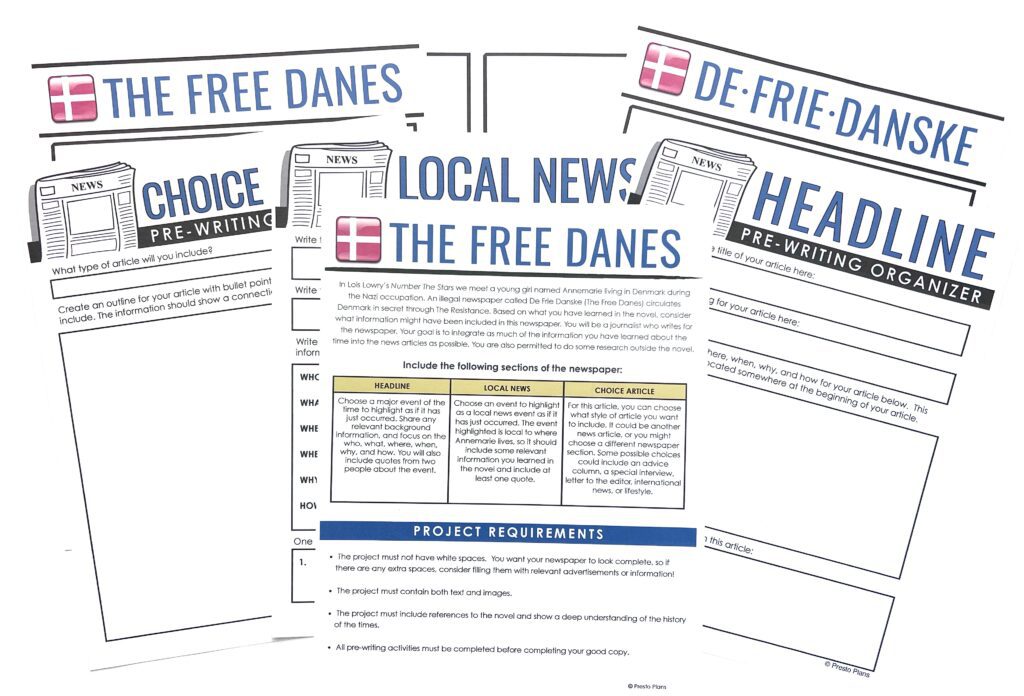
Lois Lowry’s Number The Stars contains a number of real-life historical events. One of these is the widespread circulation of an illegal newspaper called De Frie Danske (The Free Danes), which was published in various secret locations in Copenhagen by the Danish Resistance. At its peak, as many as 20,000 copies of De Frie Danske were thought to be in circulation throughout the country.
As a culminating activity, students take on the role of a journalist writing for De Frie Danske. In this assignment, they must use information from the novel, as well as from their own research, to write about a significant “headline” event from the time, as well as other local news, and a third article of their choice. Graphic organizers can help students gather their thoughts, prioritizing the 5 Ws (who, what, where, why, and when), and consider their audience. Printable templates, including columns and spaces to add drawings or images, support students as they format their finished articles in the style of a newspaper.
8. Hashtag Quote Response
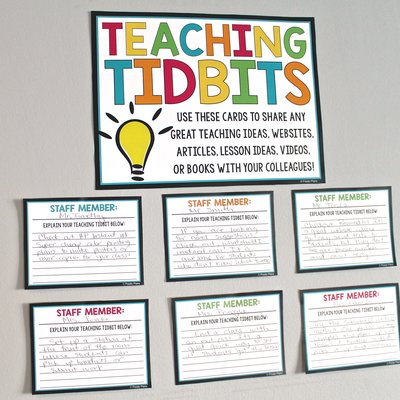
When I teach Number the Stars by Lois Lowry, I like to embed an ongoing “hashtag quote” activity throughout the novel study. This flexible task can be shared on a daily or weekly basis, or you can use it to introduce specific sections or passages from the novel.
At the beginning of the novel study, I like to dedicate a classroom bulletin board to Number the Stars. As students progress through the book, I add relevant quotes from the novel to the display, complete with hashtags that reveal the speaker (characters from Number the Stars, or Lois Lowry herself). Using printable bookmarks or exit slips, I invite students to consider the meaning behind the quotes from the display and consider whether the quote has relevance to their own lives or the world today. I find these brief check-ins help students practice making meaningful connections to the text and providing evidence to support their thoughts.
TEACHING TIP: If you’re tight on space, you can also display each quote digitally, write them on the board, or turn them into laminated discussion cards that can be collected and reused for different classes, or for years to come!

I hope this post helps you with new and creative ideas to teach Number the Stars by Lois Lowry!

Looking for more engaging novels to hook even your most reluctant middle school students? Check out these other blog posts:

Search the blog for what you are teaching


GIVEAWAYS
sent straight to your inbox!


share this post