PRESTO PLANS




Sent straight to your inbox
CLICK HERE TO ACCESS
Sign up to receive 10 ready-to-use ELA resources your students will love!
10 FREE ELA RESOURCES





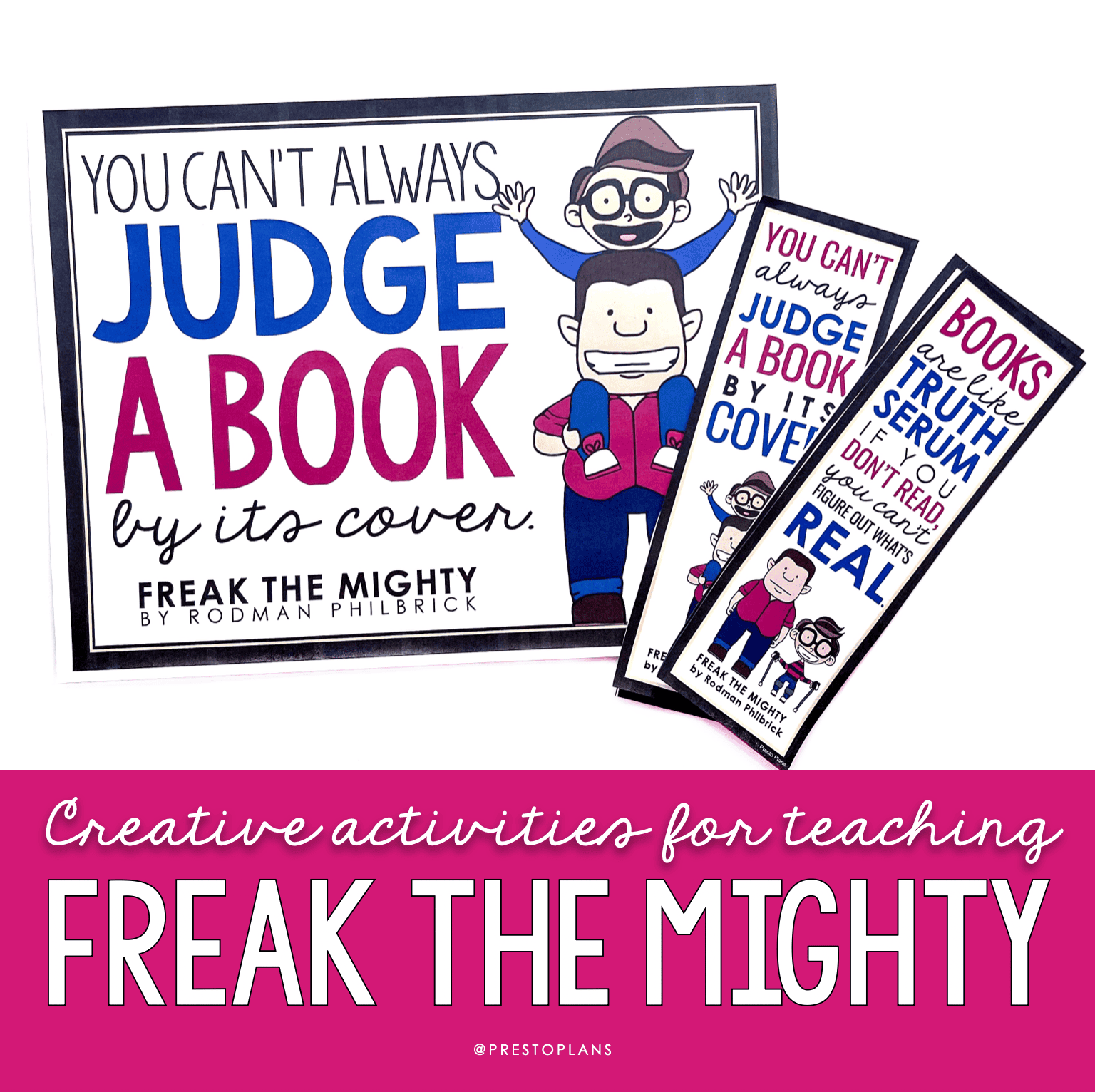
Creative Activities for Teaching Freak the Mighty by Rodman Philbrick
Looking for a middle school novel study that holds your students’ attention? Teaching Freak the Mighty by Rodman Philbrick is a great choice in middle school – especially if you have a handful of reluctant readers in your group. Written with young teenage readers in mind, Freak the Mighty is a compelling story of an unlikely friendship, featuring a cast of relatable, authentic characters. In the novel, Max, a struggling student haunted by his dark family history, quickly forms an inseparable bond with his new neighbour Kevin (nicknamed “Freak”), a brilliant boy with a physical disability.
Middle school students love Freak the Mighty for its gripping plot and emotional ending, and I love the novel’s timeless themes and accessible appeal. Freak the Mighty is a perfect text to introduce middle school students to more advanced literary techniques, including conflict and character development, while still remaining approachable. There are also many ways to incorporate creative activities that connect to social and emotional development, including the importance of empathy, inclusion, and belonging.
If you plan on teaching Freak the Mighty by Rodman Philbrick, I’ve got you covered! Here are some of my favorite creative activities to bring this unforgettable novel to life in middle school ELA.
Teaching Freak the Mighty: Introducing the Novel
Whenever I begin any middle school novel study, I like to change up my classroom decor. One of the easiest ways to do this is by creating an interactive bulletin board display. I find this low-prep approach has a major impact on middle schoolers! All you need to do is print and display one copy of the main display image (featuring Freak and Max together). Next to the image, I feature an inspiring quote from the novel, with “hashtags” that share which character said the quote. Each week (or whenever you choose to switch things up), simply swap out the quote!
TEACHING TIP: I like to laminate a full set of quotes – this saves time when changing your display and allows you to re-use the same posters year after year!
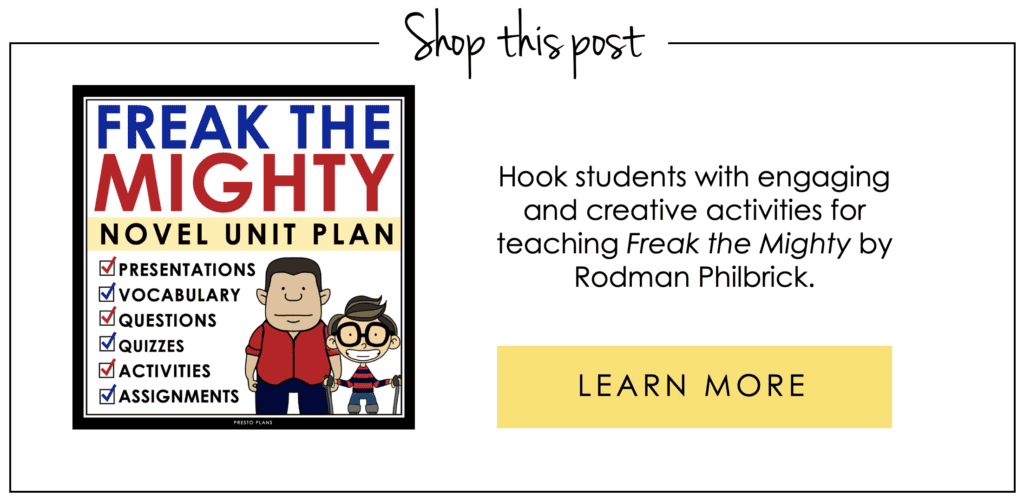
When teaching Freak the Mighty by Rodman Philbrick, I like to spark students’ curiosity about the novel by offering them a bookmark they can use throughout the unit. As I set up the beginning of my unit, I also like to prepare a set of flexible discussion cards that can be used throughout the novel study. I find these can help guide conversations in different ways – students might discuss a prompt in pairs or small groups, respond to a prompt during a personal writing exercise, or even discuss a card during a Socratic seminar or whole-class conversation.

Teaching Freak the Mighty: Chapters 1-5
In the first five chapters of Freak the Mighty, readers are introduced to Max Kane, a large but insecure boy who struggles in school, lives with his grandparents, and feels burdened by his family’s troubled past. Quickly, they also meet Kevin “Freak” Avery, Max’s new neighbour. Freak is a small, exceptionally bright boy with a physical disability, and Max soon becomes curious about him. After an awkward first encounter and a memorable Fourth of July celebration, their friendship begins to develop.
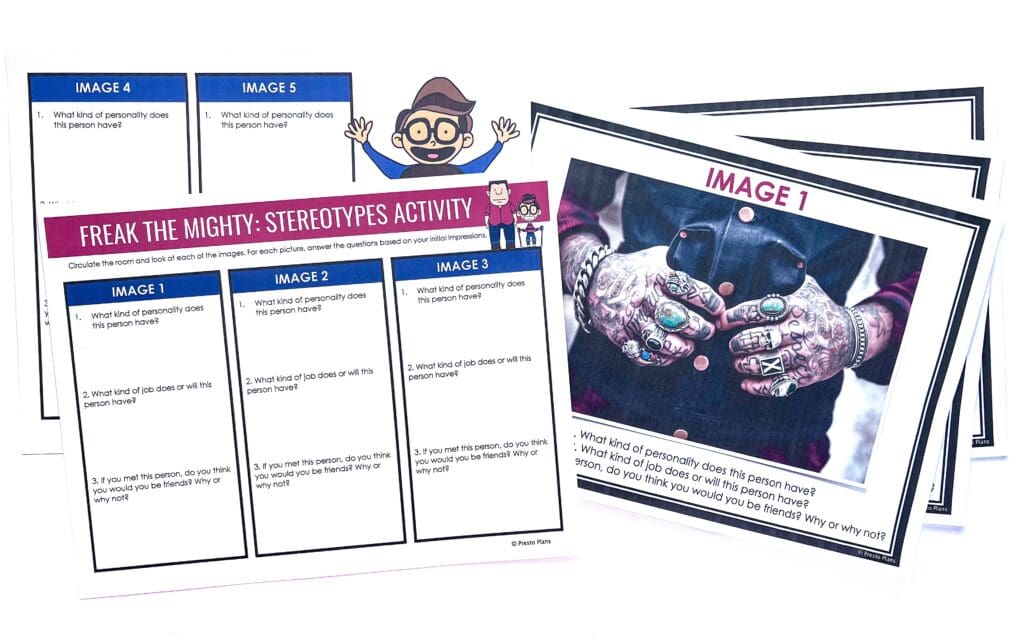
When teaching this section of Freak the Mighty by Rodman Philbrick, I find it helpful to guide students through an activity that helps them gain a better understanding of the concept of stereotypes. This low-prep task involves printing a set of five different pictures and hanging them around the classroom. From here, students work in small groups (I like three or four students per group for this task) to circulate through the different images and record their initial impressions on a graphic organizer. I find that five minutes per image works well (and you will likely find that students get slightly quicker at this activity as they move through the stations!).
Once students have had the chance to reflect on all five images, I bring them back to their own seats for a brief class discussion about preconceived ideas. If needed, I define the term stereotype as a widely held, but fixed and oversimplified, image or idea of a particular type of person or thing. Next, I invite students to reflect on the activity they just completed. Is it possible they may have been influenced by stereotypes during the activity? Finally, to wrap up, I like to make a direct connection to Freak and Max, who are both judged and stereotyped based on their physical and cognitive limitations.
Chapters 6-10: Freak the Mighty Bullying Role Play
As students dive deeper into the plot of Freak the Mighty, they will read how Max and Freak face relentless bullying from Tony D (Blade) and his gang. They endure ongoing threats and intimidation, starting with verbal attacks that eventually escalate to physical violence. The harassment they endure is not only verbal but turns increasingly physical, making their situation more challenging and dangerous. When teaching this section of Freak the Mighty, I find a bullying role-play task can be a useful way to get students up and moving, while exploring text-to-world connections.
To kick off this activity, I like to bring students together for a thoughtful discussion that sets the tone for the upcoming task. First, I clearly define bullying as when someone intentionally hurts, threatens, or humiliates another person, either physically or emotionally, repeatedly over time. Then, I guide students through a lesson that explains the differences between conflict and bullying, as well as different types of bullying (direct and indirect).
TEACHING TIP: This task can also provide a useful crossover into Health, Wellness, or other social and emotional learning lessons.
Now, students are ready to begin the interactive task! Divide students into small groups, and provide each group with a role-play card. Using the elements specified on the card, students collaborate to develop a two-part bullying role-play.
Initially, the performance will depict a bullying scenario leading to a negative outcome. In the second part, each group will demonstrate how the situation could be better handled, showcasing actions that bystanders, or the victim, could take to improve the situation.

Chapters 11-15: Freak the Mighty Dictionary
As students become more familiar with the characters of Freak and Max, they will learn that Freak has an extremely well-developed vocabulary. In Freak the Mighty, Freak provides Max with a “dictionary” of words and their definitions, which is also available for readers at the back of the book.
When teaching Freak the Mighty, I like to use this moment to inspire students to create their own version of Freak’s dictionary and showcase their vocabulary skills! Using a graphic organizer, students can share some of their favorite words, complete with funny, clever, or imaginative definitions in the same style Freak uses. They can even incorporate small illustrations to accompany each of the definitions!

Teaching Freak the Mighty: Chapters 16-20
Chapters 16 through 20 of Freak the Mighty provide rich teaching opportunities for students to explore some of the novel’s more complex characters. Readers already know that Max’s father, Kenneth “Killer” Kane, has been serving time in prison for murdering his mother, which is why Max lives with his grandparents. In these chapters, Max learns much more about his father, and the threat he represents becomes very real.
When teaching this section of Freak the Mighty by Rodman Philbrick, I like to encourage students to consider the relationship between Max and his father with two different characterization assignments:
LETTER FROM “KILLER” KANE WRITING ASSIGNMENT:
After being released from prison, Kenneth “Killer” Kane kidnaps Max and takes him to an abandoned building. Kane insists that he is innocent of Max’s mother’s murder and tries to convince Max that his grandparents and others have lied to him. Kane tells Max that he wrote him letters from prison, but that Gram and Grim threw them out. Because Max desperately wants answers about his family, he struggles to know what to believe.
For this creative writing task, students must re-create one of these “lost” letters, written by Kane from prison to Max. Students must consider Kane’s motivations, as well as examples of direct and indirect characterization, as they compose their letter.
“KILLER” KANE WANTED POSTER:
In this visual task, students create a “Wanted” poster for Kenneth “Killer” Kane. Students may find it useful to make a plan for their poster using a graphic organizer. Their poster must incorporate direct evidence from the novel to provide a physical description of Kane, as well as information on his known associates and what to do if he is encountered. Students can use a “Wanted” poster template to create a final, polished copy of their poster, which should also include a picture of Kane.

Chapters 21-25: Wrapping Up Freak the Mighty
As students read the final chapters of Freak the Mighty, three creative activities help to tie the novel together.
DON’T JUDGE A BOOK BY ITS COVER CHARACTER ANALYSIS:
In Freak the Mighty, many characters are not what they initially appear. In this character analysis task, students take a closer look at five characters from the novel: Max, Freak, Iggy, Loretta, and Kenneth Kane. All of these characters carry a “label” of some kind (either through other characters’ perceptions or the reader’s preconceived ideas), but these labels don’t necessarily turn out to be true. Using evidence from the text, students must consider how each character is different from their stereotype or label.
MORQUIO SYNDROME INFORMATIONAL BROCHURE:
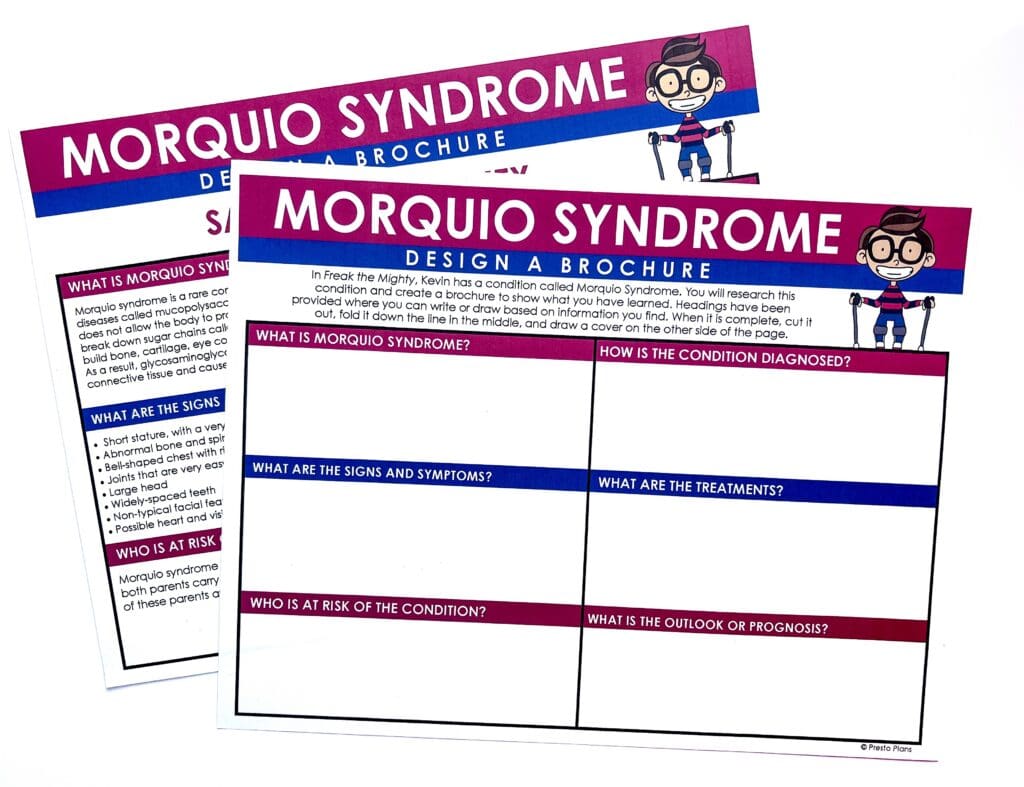
Freak (Kevin) lives with Morquio Syndrome. In this research-based task, students learn more about this condition and create an informative brochure to build understanding and awareness. A graphic organizer helps to keep students on track, manage information, and reinforce expectations for the activity.
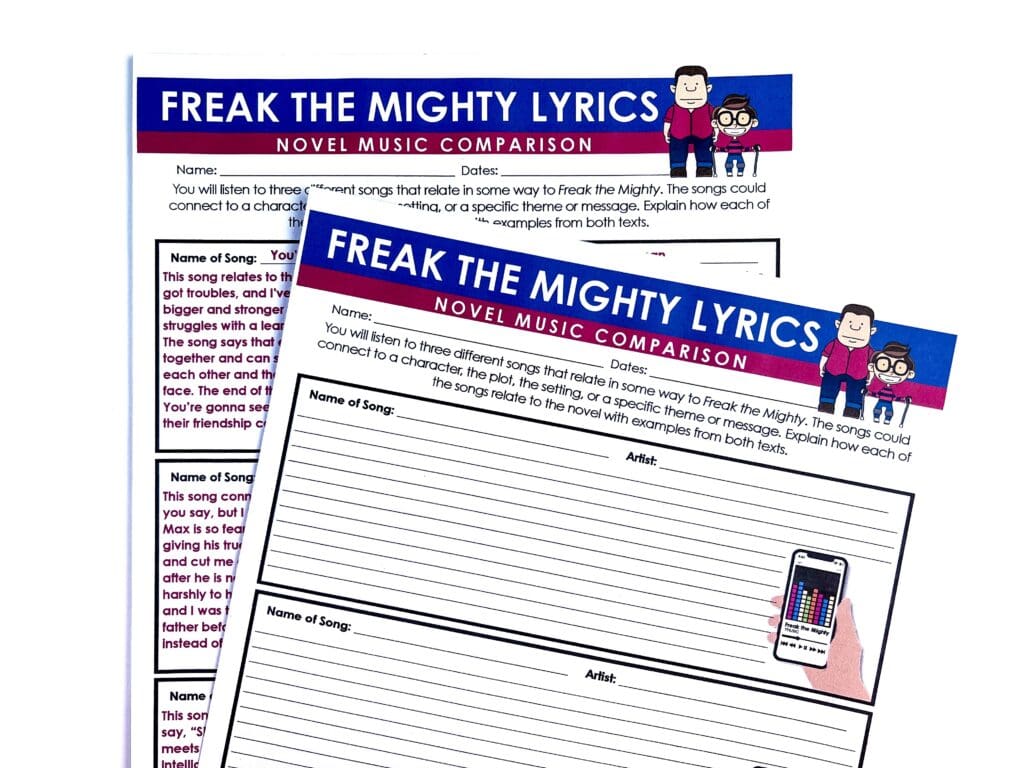
FREAK THE MIGHTY SONG LYRICS TEXT CONNECTION ACTIVITY:
One fresh and creative way to approach teaching Freak the Mighty involves an unexpected text-to-text connection. As students complete the final chapters of the novel, they can make text connections by linking song lyrics to the book’s themes, characters, and conflicts. This assignment strengthens analytical and critical-thinking skills, while allowing students to connect music to literature.
Teaching Freak the Mighty: Post-Reading Activities
Once students have finished reading Freak the Mighty, two additional post-reading activities can help them reflect on the novel as a whole.
FREAK THE MIGHTY PLOT DIAGRAM ASSIGNMENT:
A simple, effective plot diagram task helps to reinforce students’ understanding of plot and support them in recalling key details from the novel. Using a clear, ready-to-use template, students must identify the exposition, rising action, climax, falling action, and resolution of the novel. This activity is a useful way to check students’ overall comprehension of the novel and identify any areas that need further clarification or guidance.
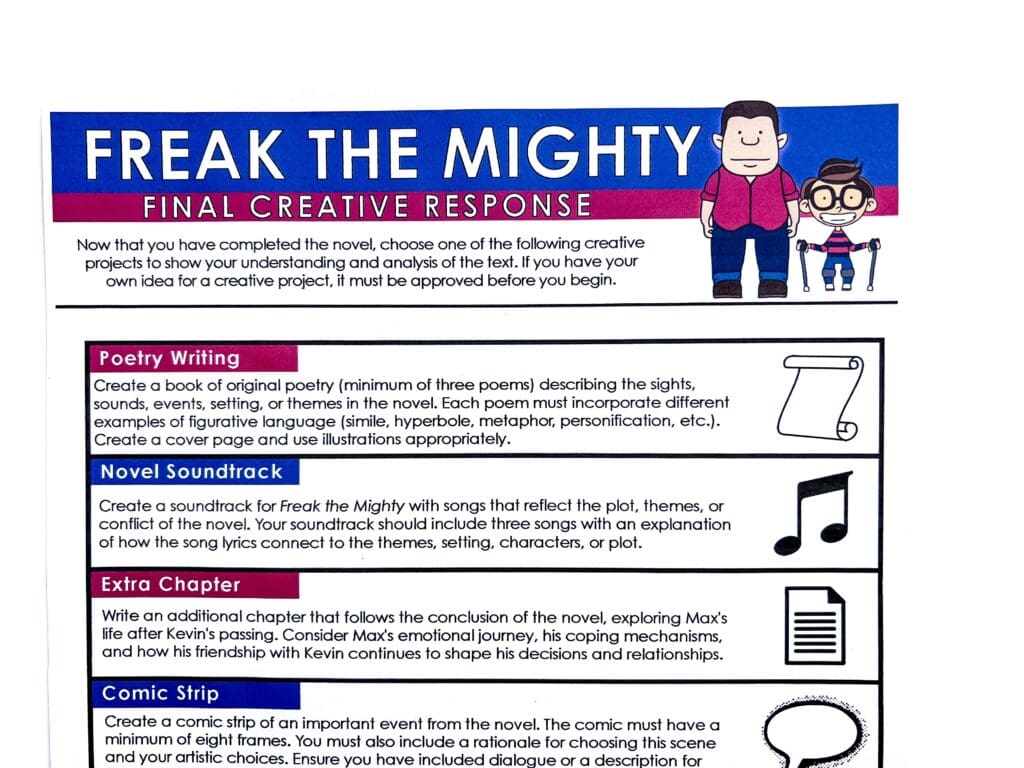
FREAK THE MIGHTY FINAL CREATIVE PROJECTS:
When teaching any novel, including Freak the Mighty, I like to end the unit with a choice-based, creative, and flexible final project. Students can choose to write poetry, create a soundtrack, write an extra chapter, design a comic strip, write diary entries, record a podcast, or film a scene from the novel. Offering many different formats for this end-of-unit task allows students to share their learning through an interest-led approach (and keeps you from having to grade dozens of similar assignments!).
Whether you’re teaching Freak the Mighty for the very first time, or you’re looking for a fresh approach to this well-loved book, I hope these ideas help you put a creative spin on your next novel study!
Search the blog for what you are teaching


GIVEAWAYS
sent straight to your inbox!



share this post