PRESTO PLANS






Sent straight to your inbox
CLICK HERE TO ACCESS
Sign up to receive 10 ready-to-use ELA resources your students will love!
10 FREE ELA RESOURCES










Teaching Shakespeare in High School: Introducing The Bard
Between the unfamiliar language, dense plots, and the pressure to “get it right,” teaching Shakespeare to high school students can feel intimidating at first. Believe me, I’ve been there! But here’s the secret…you don’t need to be a Shakespeare expert to teach his work well. In my experience, a collection of creative introductory lessons can provide high school students with context for Shakespeare’s literary works and offer an effective springboard for a deeper study of one of his famous plays.
With a clear purpose, an appealing entry point, and a few smart strategies, your Shakespeare unit can become one of the most engaging and meaningful parts of your ELA curriculum. From attention-grabbing visuals to vocabulary-building activities, here are five of my tried-and-tested tips for teaching Shakespeare in high school ELA.

SHAKESPEARE’S LIFE & TIMES
I like to begin teaching Shakespeare by providing a big-picture foundation that makes his work feel approachable and relevant to high school students. I find that when teens have a bit of context for Shakespeare as an actual person living in a specific time period, they are able to engage more deeply with his writing. To start, I like to provide an opportunity for students to discuss the lasting impact of Shakespeare’s works. I usually ask some variation of the following prompts to guide the discussion:
- What do you know about William Shakespeare?
- Why do you think Shakespeare’s works are still studied today, centuries after they were originally written?
- Do you think it is more enjoyable to read a play or to see a performance?
Depending on the dynamic of your learning space, this can be an engaging whole-class discussion, or it can easily be adapted into stations or small-group discussions.
From here, my next step is to guide students through a structured lesson. This helps them build background information about Shakespeare’s life, family, and career. Next, students learn about the major types of Shakespearean drama – tragedies, comedies, and histories – and the characteristics that define each genre. I also like to briefly touch on the historical context of the Tudor Period and the Renaissance, and how these influences shaped Shakespeare’s writing.

SHAKESPEARE’S HASHTAG OF THE WEEK
Bring Shakespeare into the 21st century with an interactive bulletin board display! In my experience, attention-grabbing classroom visuals can spark conversations and are a low-pressure – and often humorous – way to expose students to Shakespeare’s vocabulary and turns of phrase.
To make Shakespeare visual for middle and high school ELA students, I first like to select a high-visibility location. Two places that always work for me are the front of the classroom (especially if you have a smaller bulletin board next to your white board or display screen) or high-traffic areas, like a breakout space or right beside the classroom door.
From here, I like to print a colour portrait of William Shakespeare – updated to include cool sunglasses, of course! I also like to print and prepare a series of interchangeable “speech bubbles.” Each “bubble” contains a quote from one of Shakespeare’s plays, and a hashtag featuring the play’s title. If you plan to switch out your quotes on a regular basis, you can set your display up with a “Hashtag of the Day” or “Hashtag of the Week” label.
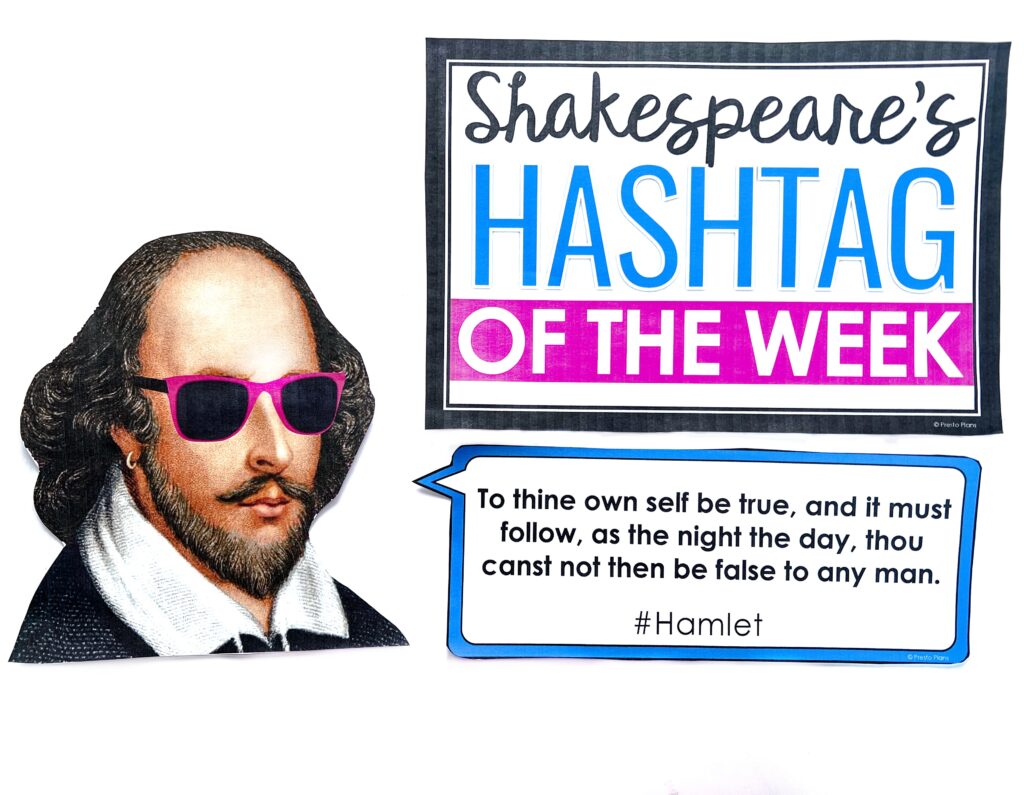
Each time I change the quote, I invite students to spend a few minutes considering what they think the phrase means, as well as whether the message still rings true in modern times. They can jot down their impressions on a graphic organizer, which can be completed as a bell-ringer or end-of-class exit ticket. I like to keep these and refer to them throughout the unit. This activity is a quick and easy way to measure students’ comprehension and progress as they get more familiar with Shakespeare and his works.
SHAKESPEARE WEBQUEST ACTIVITY
In my opinion, there’s no better way to build background knowledge and spark students’ curiosity about Shakespeare than by putting them in the driver’s seat! A webquest activity offers students the perfect blend of structure and self-guided research. I like to begin teaching this section of my Shakespeare intro by providing high school students with a print-and-go handout. This graphic organizer is an easy place for students to jot down information and impressions, as they navigate through a series of pre-approved online resources to help them gain a more complete picture of Shakespeare’s life and works.
Each section of the handout contains a QR code that students can follow to learn more about the Bard. From exploring Shakespeare’s childhood home in Stratford-upon-Avon to a virtual tour of the Globe Theater in London, students can experience a “virtual field trip” to significant places in Shakespeare’s life. Video links also connect students with modern-day allusions to Shakespeare, and invite them to consider his lasting impact on the English language. As students complete the webquest, thoughtful prompts also invite them to engage more deeply with their research and note key takeaways that help them understand more about Shakespeare and the world he lived in.

WHAT WOULD SHAKESPEARE SAY?
I find that many students are intimidated by Shakespeare’s language and vocabulary. This is especially true if they are encountering his work for the first time. This is why I always devote at least one or two lessons at the beginning of a Shakespeare unit to teaching high school students about some of the most commonly-used words and phrases they will encounter in his plays. Addressing worries about language and vocabulary head-on can ease students’ nerves and make Shakespearean texts more approachable. My goal is to help students feel prepared, capable, and ready to tackle the Bard’s works.
To begin, I guide students through a highly structured lesson, focusing on the “everyday” language of Shakespeare’s time. As I share specific information about some of the words they are most likely to encounter (such as thou, thee, and ye as alternative forms of you), students keep track of commonly-used phrases on a one-page graphic organizer. This helps them build an accessible vocabulary reference sheet, which they can refer to throughout the unit.
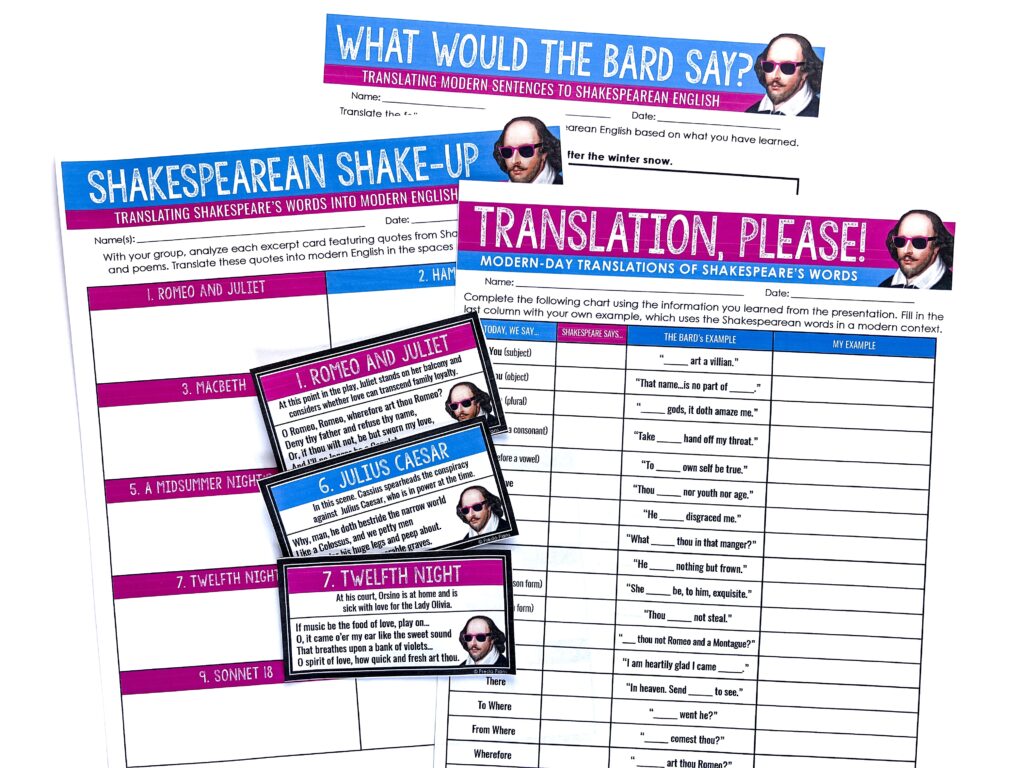
I find that students learn best when they have regular opportunities to apply and practice their skills. This also helps me quickly gauge when the class is ready to move on to a new concept, or if they need a bit more practice. Throughout the lesson, I like to provide opportunities for students to collaborate with each other and experiment with Shakespearean language. Discussion cards, an activity where students translate modern sentences into Shakespearean English, and opportunities to experiment with language (and even invent a new word!) add interactive elements and help to reinforce the lesson.
TOUR THE GLOBE THEATER
The Globe Theater (or Theatre, in UK English!) has been a London landmark since the time of Shakespeare himself. When teaching Shakespeare to high school students, I find it useful to share a bit about the famous theater where Shakespeare’s plays have been performed regularly since the 16th century. This helps them visualize Shakespeare’s works in context. It also supports their understanding of his plays as living, breathing performances, rather than just words on a page.
Throughout the lesson, I invite students to keep track of the various parts of the theater. The “Label the Globe” graphic organizer features a labelled diagram. It also contains space to record the names and functions of the various spaces within the building. Students are often captivated by small details, such as the practice of flying different colored flags atop the theater to signal the type of play being performed (red for histories, black for tragedies, and white for comedies).
I like to wrap up the lesson by showing students a short video clip of the comedy Much Ado About Nothing performed on the Globe Theater stage!

Hopefully, this post helped to settle your nerves about teaching Shakespeare in high school ELA! To help you get started, all five of these introductory lessons and activities are available in my Introduction to Shakespeare Bundle. This low-prep resource contains everything you need to kick-start your next Shakespeare unit!

Looking for more creative ways to celebrate Shakespeare in high school ELA? Why not celebrate his birthday with your class? You can read my party-planning tips in my post Throw Shakespeare a Birthday Party!
Search the blog for what you are teaching



GIVEAWAYS
sent straight to your inbox!



share this post