PRESTO PLANS





Sent straight to your inbox
CLICK HERE TO ACCESS
Sign up to receive 10 ready-to-use ELA resources your students will love!
10 FREE ELA RESOURCES









Teaching “The Leap” by Louise Erdrich
If you want to spark meaningful discussions with your middle or high school students, teaching “The Leap” by Louise Erdrich is a great choice. Originally published in Harper’s magazine in 1990, “The Leap” is told through a series of recollections about the narrator’s mother, Anna Avalon, who is a former trapeze artist in a travelling circus. Containing vivid language and imagery, “The Leap” allows students to take a deeper look at themes of grief and loss, courage, and the complex relationship between parents and their children.
I love teaching “The Leap” because it offers so many different opportunities for students to explore vocabulary and figurative language, make connections, and dive more deeply into the text. It might even inspire students to create and share an original story of their own!
Here’s how I like to approach teaching “The Leap” by Louise Erdrich in upper middle or high school ELA.

Build Background Knowledge
When teaching any short story, including “The Leap” by Louise Erdrich, I like to start by providing students with a bit of background information. First, I like to share some information about Louise Erdrich, who won the 2021 Pulitzer Prize for Fiction for her novel The Night Watchman.
Born in 1954 in Little Falls, MN, Erdrich is the daughter of a German-American father and a First Nations Anishinaabe mother. A trailblazer from a young age, she was among the first classes of women accepted to study at Dartmouth College. Known for her award-winning novels, poetry, and children’s books – many of which contain Native American characters, settings, and themes – Erdrich often credits her writing style to the oral storytelling traditions of the Anishinaabe culture.
The Anishinaabe people, also known as Chippewa or Ojibwe, have orally passed down stories for generations. The characters and events in “The Leap” are not based on any historical events or on Erdrich’s life. However, in “The Leap,” she uses the oral storytelling tradition of focusing on a central, unifying figure and following that person through significant incidents in their life.
Pre-Reading Discussion
I find teaching a short story like “The Leap” is much more effective when students can participate in a few pre-reading activities and discussions before diving into the text. To build anticipation and get students thinking about some of the ideas in Louise Erdrich’s short story, I like to invite them to sit in their seats while I show them a series of statements. If they agree with the statements, they stand, and if they disagree, they remain seated.
Some of the statements I like to share include:
- Parents should put their children’s needs before their own
- You should be willing to put yourself in harm’s way to help those you love
- People can lead happy lives after significant tragedies
Once the activity is finished, I like to have students share why they chose to stand or remain seated – this can often prompt some lively discussions!
From here, I also like to have students explore and consider some additional questions as they prepare to read “The Leap.” Depending on the group, I might like to set each question up as a discussion station, or lead a whole-class discussion or debate. Alternatively, a “silent discussion” where students jot down their thoughts on paper and build on each others’ ideas without speaking, can be a creative way to explore these prompts:
- Have you ever taken a risk?
- How would you cope with losing one of your senses?
- Are people naturally selfless?
- What does it mean to act courageously?

Reading the Story
From here, it’s time for students to read “The Leap.” During the reading, I like to invite students to pay attention to Louise Erdrich’s carefully-chosen language and the subtle details in the narration that bring this story to life.
You might like to have students read silently, or you might prefer to read the story out loud to the class. If you have the flexibility and space to do so, I find that it can even be useful to divide the class into two groups – independent readers and those who need a bit more guidance and prompting as they work with the text.
Post-Reading Discussion
Once students have finished reading “The Leap,” I find it useful to help them unpack the story by exploring some of its key ideas and themes. I like to begin by having students consider how the narrator feels about her mother. This can be a useful opportunity for students to practice re-reading the text and support their thinking with specific evidence.
I also like to have students reflect on specific passages from the story. For example, students can consider the meaning behind Anna Avalon’s words, “As you fall, there is time to think.” They can also consider why Anna never told the narrator about the accident, and why her blindness is significant to her character.
Vocabulary Game
One thing I love about teaching “The Leap” by Louise Erdrich is that it provides an excellent opportunity for students to practice vocabulary skills. To clarify some of the more challenging terms from the story, I like to play a fun vocabulary game! This activity can be a useful way to explore and reinforce less familiar vocabulary terms and can be used individually or collaboratively.
First, students must examine a list of words from the story and another list of definitions. From here, they must match each definition with the correct word. Once they have made their matches, students write the corresponding word in the boxes below each definition on the provided handout. As a final challenge, they must solve a final mystery word! To do this, students take the letters from the colored boxes and unscramble them to reveal a hidden word.

Literary Device Sorting Game
Teaching “The Leap” by Louise Erdrich can also support students’ understanding of literary devices. In this print-and-go activity, students must identify and categorize examples of three specific literary devices: metaphor, simile, and personification.
I like to organize students into pairs for this activity, although it also works well as a classroom station. To prepare for this hands-on task, you’ll want to print out a set of quotes from the text for each pair of students. You will also want to make sure that each group has a copy of the Literary Devices Sorting Game graphic organizer.
Paper-Saving Tip: The provided handout for this activity is formatted so that two sets of quotes print on a single page!
If you prefer to plan ahead, you can cut out each of the quotes and put them into an envelope or sealed plastic bag. Alternatively, students can cut out the strips of paper when they receive their handout! Once the paper strips are ready, students examine the passages from the text and identify which literary device is being used. Once they have placed the paper strips in the correct categories, they can tape or glue them down.

Reading Questions
Once students have a good handle on the vocabulary and literary style of “The Leap,” I find reading questions can be a useful way to dive deeper into the content of the story. Reading questions can be used as formative or summative assessment tools, as a springboard for further discussion (in small groups or as a whole class), and as a way to check students’ overall comprehension of the text. They can also be used to introduce or reinforce other literary analysis terms, including symbolism, conflict, and theme.
Students can complete the questions individually, or you could also differentiate this task by cutting up the sheet of questions so that each student can respond to a different prompt. No matter how you choose to use reading questions, I find it useful to remind students to support their thoughts with specific evidence and examples from the text.
Once students complete the questions, I like to bring the class together to review the responses and clarify their understanding.
Circus Poster
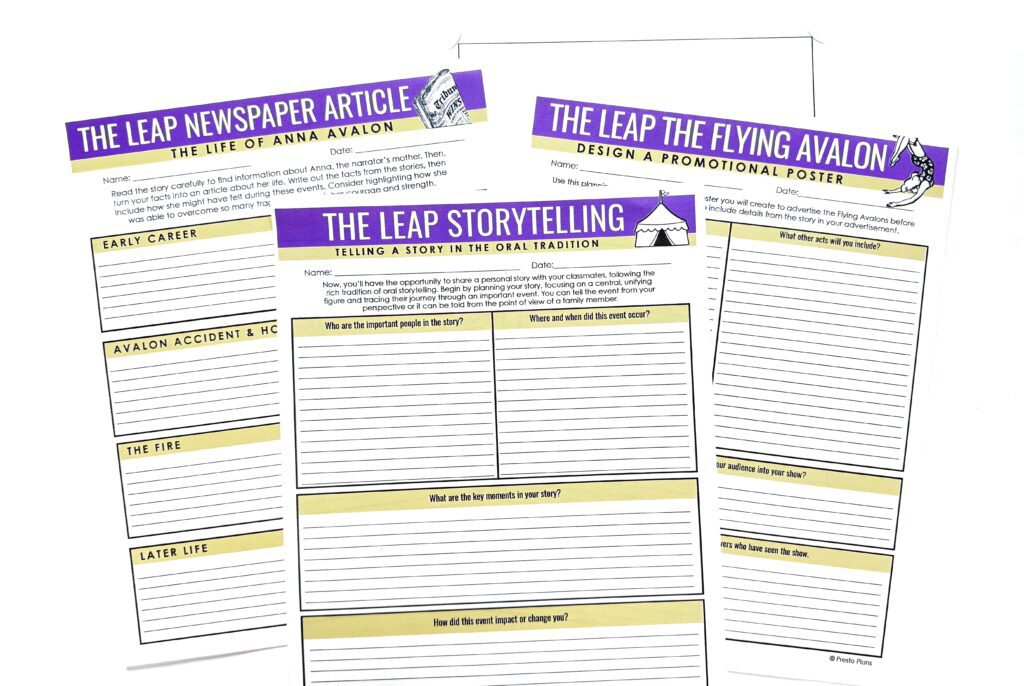
If you’re looking for a way to incorporate visual literacy while teaching “The Leap” by Louise Erdrich, why not have students design a circus poster? In the story, Anna Avalon is a trapeze performer in a traveling circus. For this activity, students will need to design an eye-catching poster to advertise the circus, using details from the story.
To begin, I like to have students brainstorm ideas and create a plan to highlight the most exciting and unique aspects of the show. After they have developed their concept, they can bring it to life with a bold, creative design. The idea is to captivate the audience’s attention and entice them to attend the famous performance!
Newspaper Article Activity
It can be interesting to incorporate a writing activity when teaching “The Leap” by Louise Erdrich. If this appeals to your students, consider asking them to take on the role of a newspaper reporter! In this creative task, students imagine they are a reporter who has been assigned to write a compelling article about the extraordinary life of Anna Avalon. I like to ask them to pretend they have an exclusive opportunity to sit down and speak to Anna one-on-one. In this interview, “Anna” shares her thoughts and emotions during the most significant moments of her life.
As students imagine how Anna would offer unique personal insights to their article, they can create a vibrant text that captures both the facts and feelings behind her incredible journey.
“The Leap” Extension Activity: Oral Storytelling
If you’re looking to extend students’ understanding of the storytelling techniques used in “The Leap,” why not add an unexpected twist? Louise Erdrich draws heavily from the Anishinaabe tradition of oral storytelling in her writing. To begin, I like to share with students that historically, the purpose of telling stories in this way was to share important information. This included customs, rituals, history, beliefs, relationships, and traditions. Many stories survived hundreds of years with incredible accuracy due to their careful practices.
In this task, students will prepare a personal story to share with their classmates, following the rich tradition of oral storytelling. To support planning, a graphic organizer can help students develop and focus their ideas. As students work through their ideas. I like to prompt them to consider how they can tell their story with clarity and emotion. Many students also benefit from a reminder about the importance of body language. This is essential to consider when speaking, and also when demonstrating active listening skills. I encourage students to engage their audience directly, rather than reading from their planning pages.
There you go! I hope this post gives you some fresh ideas if you plan on teaching “The Leap” by Louise Erdrich!

Looking for another great short story to teach in middle and high school ELA? Check out my blog post with tips for teaching The Treasure of Lemon Brown by Walter Dean Myers.
Need new ideas to support middle and high school students in growing their literacy skills? Don’t miss my post on How to Teach Close Reading to Middle and High School Students!

Search the blog for what you are teaching




GIVEAWAYS
sent straight to your inbox!



share this post