PRESTO PLANS





Sent straight to your inbox
CLICK HERE TO ACCESS
Sign up to receive 10 ready-to-use ELA resources your students will love!
10 FREE ELA RESOURCES









Creative Activities for Teaching Romeo and Juliet by William Shakespeare
Teaching William Shakespeare’s Romeo and Juliet can feel like a big task, especially when you want students to engage in creative, purposeful activities to help them comprehend the story. Luckily, this classic play is full of themes teens recognize – from love and loyalty to conflict, and impulsive choices. In my experience, once they get the hang of Shakespeare’s language, many students are surprised that the drama actually feels quite modern, despite being more than 400 years old!
For me, intentional planning is the key to keeping Shakespeare’s plays fresh for 21st-century audiences. With clear structure, a bit of friendly competition, and plenty of creative activities to reinforce and modernize Shakespeare’s drama, teaching Romeo and Juliet can be a lot of fun for students – and for you, too! Here are my favorite creative activities for teaching Romeo and Juliet in high school ELA.
Setting the Stage: Romeo & Juliet Posters
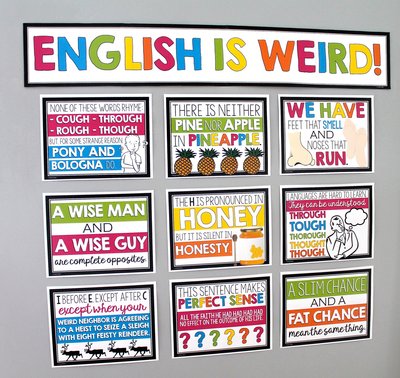
When teaching any new text, including Romeo and Juliet, I find it can be helpful to set the stage with a quick classroom refresh. Eye-catching posters can be a funny, engaging, and low-prep way to hook students’ attention before the lesson even begins!
To keep things simple, I like to dedicate just one bulletin board to my current unit of study. Before beginning a new unit, I like to quickly switch up this display. I find this keeps things fresh for students and provides a preview of what they will learn! For teaching Romeo and Juliet, I like to use creative and colorful posters that incorporate quotes from the play, as well as provide funny commentary.

Pre-Reading: Montague vs. Capulet Family Feud
Before diving right in to Romeo and Juliet, I like to introduce a fun and friendly competition to the class! I begin by explaining that the feud in Romeo and Juliet is a long-standing, bitter conflict between the Montague and Capulet families.
This feud serves as the central obstacle to the young lovers’ happiness. From here, I explain that as we study the play, students will be divided into one of “two houses” – the Montagues or the Capulets. Throughout the unit, these two “families” will compete in a series of challenges. Like the classic game show Family Feud, Montagues and Capulets will have opportunities to compete and earn points for the “ultimate prize!”
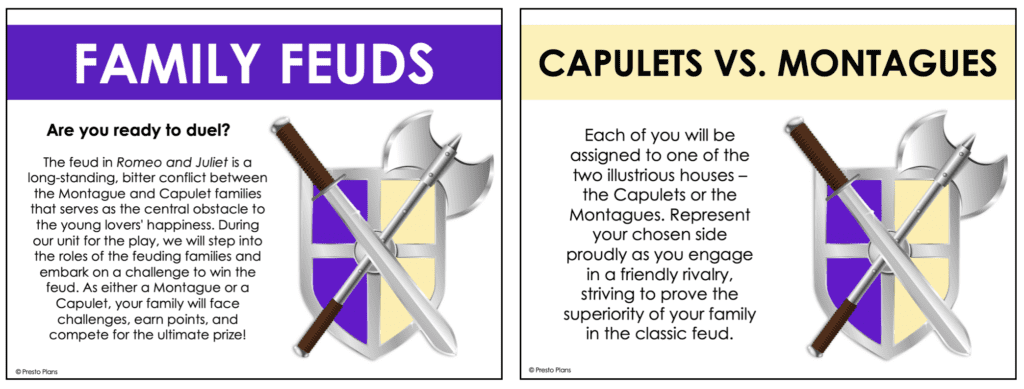
Once students have been divided into two families, it can be fun to kick off the first challenge. That is, designing a family crest! Each group can use a ready-to-print template to design their crest using symbols, words, and colors to represent their assigned family. These crests can become part of your Romeo & Juliet display board. This is where you can also keep a running total of Montague vs. Capulet points throughout the feud.
Montague vs. Capulet Family Feud challenges at the end of each of the play’s five acts provide an interactive, collaborative way for students to demonstrate and refine their comprehension and vocabulary skills. These challenges also help them showcase their understanding of characterization, themes, and literary techniques.
TEACHING TIP: Challenge prizes don’t have to break the bank. Think about what might be an appealing way to motivate your students, and go from there. You might have a coveted “Reigning Champions” plaque or trophy that remains in your classroom for years.

Act One: Shakespearean Insult Battle
“Thou art a boil, a plague sore, an embossed carbuncle!” If someone said this to your students, what would they do? This quote, from King Lear, is a perfect example of the Bard’s creative insults. Many appear throughout Romeo and Juliet.
In this creative challenge, students carefully consider how Shakespeare integrated insults into dialogue as a way to develop characters, create conflict, and add humor. Working individually, in pairs, or in small groups, students examine a list of six insults used by different characters in the first act of Romeo and Juliet. From here, they must write a modern “translation” of each insult.
This task will then become the first challenge in your ongoing Montague vs. Capulet Family Feud! Each “family” will review the insults and select two representatives to deliver their best barbs with Shakespearean flair!
Some of the categories I like to add are:
- The Bard’s Wit: To the student who uses the wittiest wordplay.
- Best Delivery: To the student who can deliver their lines with the most flair.
- Unexpected Zinger: To the student with the most imaginative insult.
It’s a good idea to remind your students that any “insults” they create must be school-appropriate!

Act Two: Texting & Wedding Speeches
When teaching a complex text like Romeo and Juliet, I find creative activities that add a modern “twist” can support students’ understanding of each character’s qualities and motivations. At the end of Act Two, I like to have students complete two tasks to support comprehension and characterization.
STAR-CROSSED TEXTING ACTIVITY
In this task, designed to be completed at the end of Act Two, students imagine that Romeo and Juliet are living in the present day, equipped with the latest smartphones.
Making specific reference to the play, they must re-imagine the iconic balcony scene as a text messaging conversation. Using a provided template, students can update the dialogue between the star-crossed lovers for digital communication – emojis and all!

WEDDING SPEECHES
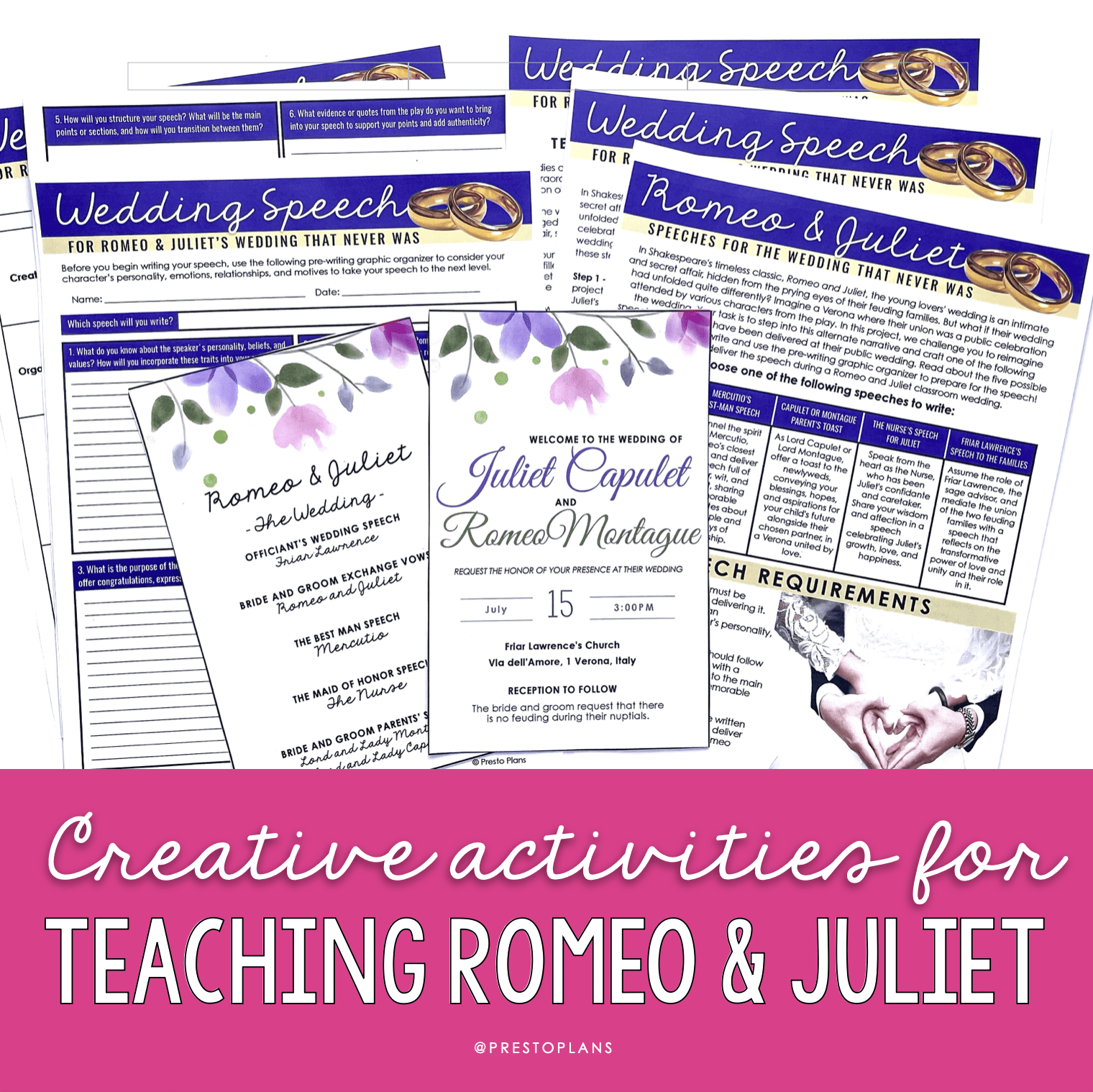
This collaborative task is the second of five Romeo and Juliet Family Feud challenges! Here, students must imagine that they are honored guests at the grand, public wedding of Romeo and Juliet. To make the event truly memorable, members from each house take on the roles of various characters, delivering speeches during this joyous occasion.
Points will be awarded for each of the following speeches:
- Best Romeo Vows
- Best Juliet Vows
- Best Mercutio Speech
- Best Nurse Speech
- Best Lord or Lady Capulet Speech
- Best Lord or Lady Montague Speech
- Best Friar Lawrence Speech

A pre-written script for the teacher allows you to easily introduce and conclude the “wedding.” Graphic organizers and clearly written instructions support students through the process of writing and rehearsing their wedding speeches.
Act Three: Sonnet Slam
Shakespearean plays like Romeo and Juliet provide a natural opportunity to infuse creative poetry activities into your teaching plans! I like to use Act Three of Romeo and Juliet as a springboard to explore Shakespeare’s famous sonnets.
To start, I explain that sonnets are 14-line poems that follow a very specific structure and format. A guided lesson and printed reference notes introduce general information about the characteristics of a sonnet, as well as several examples. Next, students apply this information as they compose sonnets of their own!
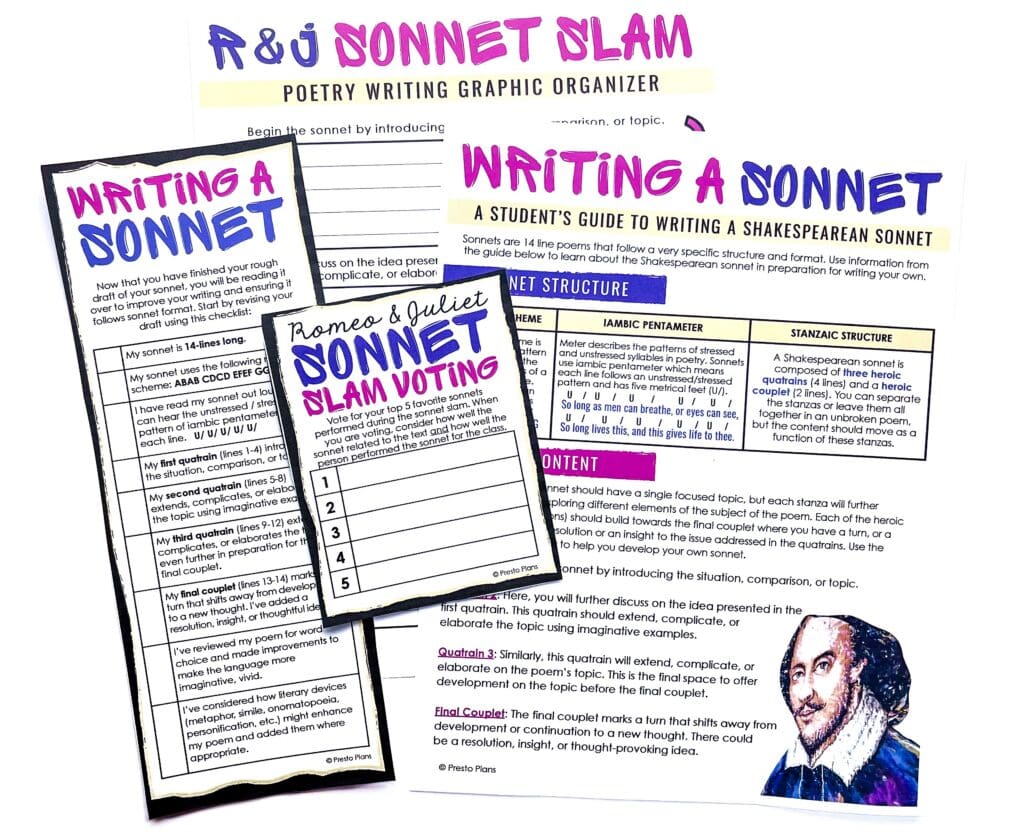
A clear, structured graphic organizer guides students through the content they need to include in each of their sonnets’ three quatrains, as well as the final rhyming couplet. Once their draft is completed, students can then refer to a provided checklist to ensure their sonnet has all the required elements and contains imaginative vocabulary and vivid figurative language.
Finally, students can share their sonnets with the class for the third Family Feud challenge! In pairs (one student representing each “house”), students engage in a sonnet “battle” until each person has had the opportunity to perform. The most points will be awarded to the “most poetic” house, with fewer points for individual students in the following categories:
- The Lyrical Legend: To the student whose wordplay skills shone among the brightest of stars!
- The Outstanding Orator: To the student whose oral performance of their sonnet was something to behold.
- The Poet Laureate: To the student, transcended the divided houses with a sonnet everyone could love (voted by students).
Act Four: Social Media Profiles and Soliloquy
In the fourth act of Romeo and Juliet, Friar Lawrence walks Juliet through a complicated plan to fake her own death – avoiding marriage to Paris – and reunite with Romeo. When teaching Romeo and Juliet, I like to incorporate two creative activities to challenge students’ comprehension and characterization skills.
SOCIAL MEDIA PROFILE
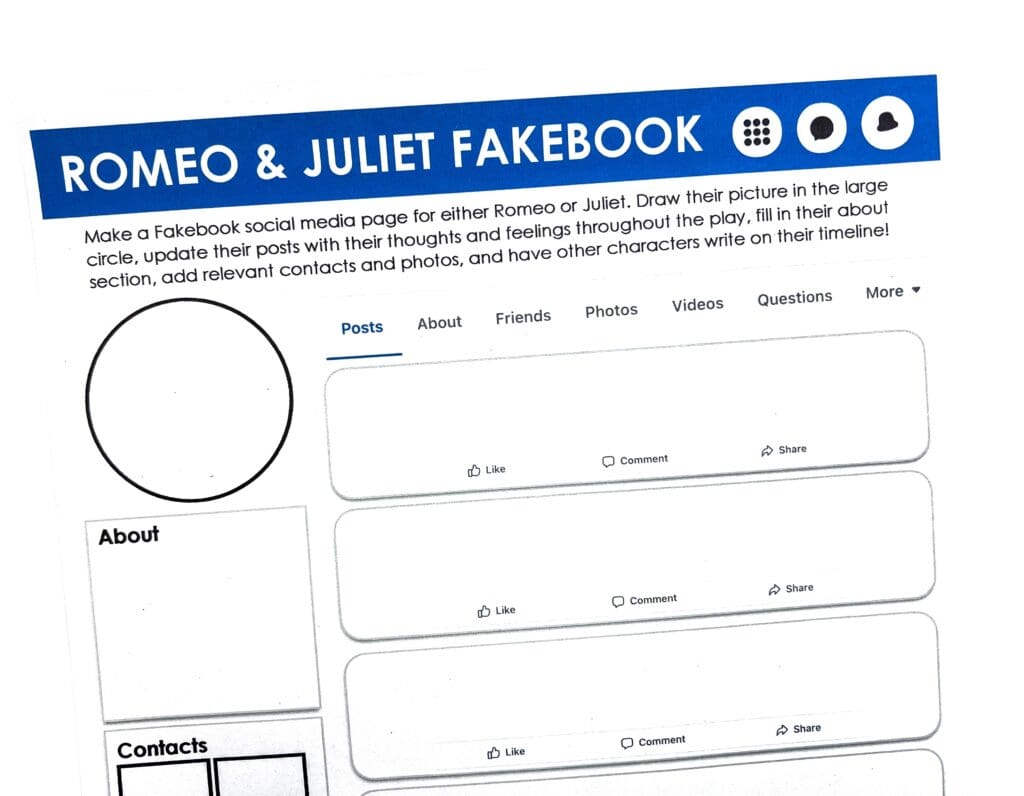
To support students’ understanding of characterization, I encourage them to think about how a modern-day Romeo or Juliet would represent themselves on social media! Using a “Fakebook” template, students can choose to design a social media profile for either of the two title characters.
As they complete their online profile, they must consider how the character might express certain feelings or post about certain events throughout the play so far. Additionally, students can include messages or public posts from other characters, as well as photos, relevant contacts, and “likes!”
JULIET’S SOLILOQUY ACTIVITY
For this reading comprehension task, students take a deep dive into Juliet’s moving soliloquy, which she delivers just hours before she drinks Friar Lawrence’s potion. Working in pairs, students carefully dissect the text and select the best answer from a series of multiple-choice questions about the passage. Choosing the correct answers will reveal a mystery word, which students can then reveal to the teacher.
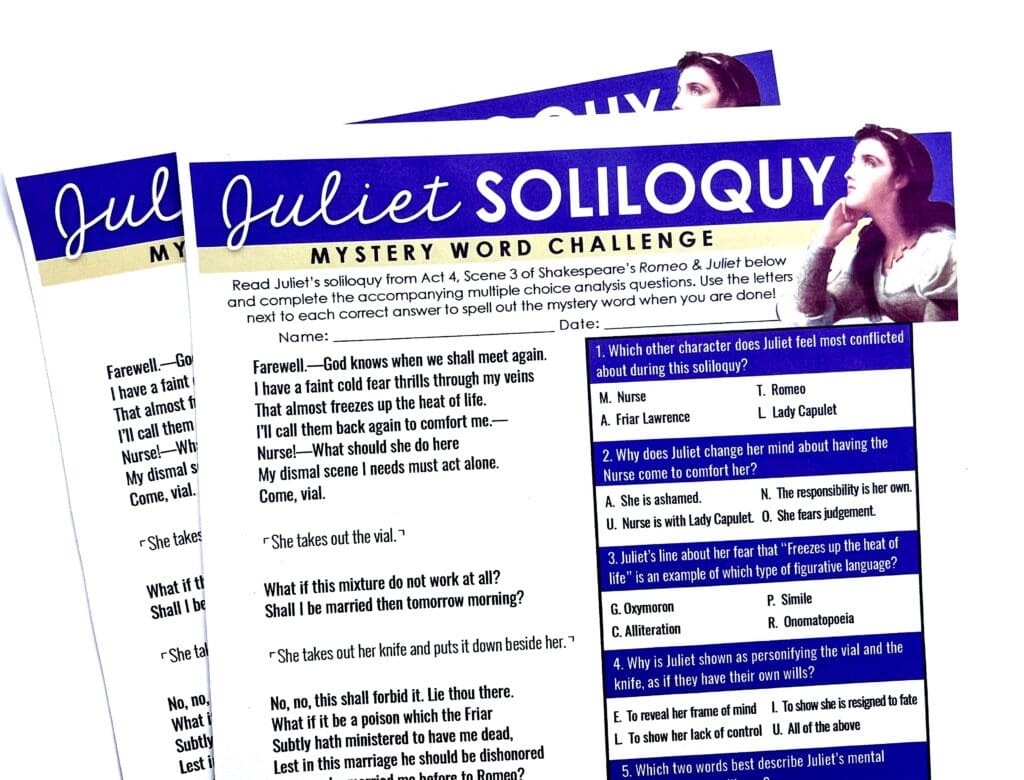
This comprehension activity can be used as the Family Feud challenge for Act Four. To compete for points, pairs of students must be from the same “house,” and they must complete the challenge within a certain timeframe. Each pair gets only one chance to check their mystery word with the teacher, and they must not share their answers with any other pairs.
Act Five: Friar Lawrence On Trial
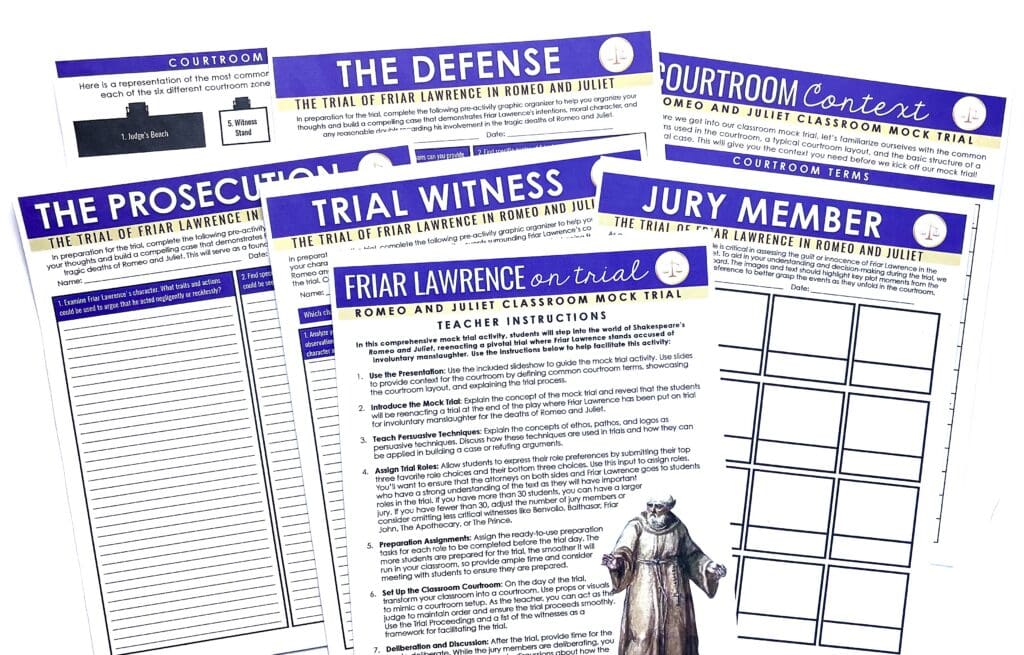
As students complete the final act of Romeo and Juliet, they might have strong – and conflicting – feelings about whether or not Friar Lawrence is to blame for the tragic ending of the play. In this creative and collaborative activity for teaching Romeo and Juliet, students will take on various courtroom roles as they put Friar Lawrence on trial.
Up to 30 different student roles are available for this learning activity. I like to assign them so that students from both “houses” are equally represented. Some students will represent the prosecution and defense, while others will take on the roles of witnesses or members of the jury. Once students have been assigned their roles, it’s helpful to explain – using a guided lesson – the general proceedings inside a courtroom, as well as specific terminology they might encounter during the trial.
From here, students prepare for the trial using graphic organizers to help them structure their arguments.
Once the trial has wrapped up, I like to award the final points for Montague vs. Capulet Family Feud based on the following criteria:
- Most Convincing Attorney
- Best Witness Testimony
- Outstanding Jury Deliberation
- Best Character Impression
- Best Dressed
- Best Use of Text Evidence
There you go! I hope this post gives you lots of creative ideas and activities for teaching Romeo and Juliet in modern-day ELA.
Did you know that all these creative activities for teaching Romeo and Juliet, plus ready-to-print posters, structured lessons, summary cards, comprehension quizzes, writing tasks, and much, much more, are available in my complete Romeo and Juliet Drama Unit? Click below to take a closer look.

Looking for ideas about how to introduce your Shakespeare unit? Check out my previous post, Teaching Shakespeare in High School: Introducing the Bard!


Search the blog for what you are teaching




GIVEAWAYS
sent straight to your inbox!



share this post