PRESTO PLANS




Sent straight to your inbox
CLICK HERE TO ACCESS
Sign up to receive 10 ready-to-use ELA resources your students will love!
10 FREE ELA RESOURCES







Creative Activities for Teaching William Shakespeare’s Hamlet
If you’re wondering where to start when it comes to teaching William Shakespeare’s Hamlet, don’t worry! I’ve been there. Teaching one of Shakespeare’s most complex dramas can feel overwhelming at first.
However, in my experience, once students gain confidence with Shakespeare’s language, they can often make fresh and insightful connections to Hamlet. After all, this classic tragedy raises relevant discussions about identity, trust, mental health, and decision-making – all of which are issues impacting 21st-century students. With careful planning and a few creative activities up your sleeve, teaching Hamlet can be a truly rewarding experience.
Whether you’re teaching Shakespeare for the very first time or looking to breathe new life into your Hamlet unit, here are some of my favorite creative lessons and activities to help you build students’ confidence and make the most of this iconic work of literature.

Teaching Shakespeare’s Hamlet: Pre-Reading
I find that students approach the text with more confidence if they are able to explore the language and characters found in Hamlet before the “official” reading begins. This is why I like to spend a bit of time familiarizing them with Shakespeare’s writing style and previewing the text before diving in!
For a quick print-and-go pre-reading activity, I encourage students to gather in pairs or small groups to examine a selection of quotes from Act 1 of Hamlet. First, I ask them to read each line aloud. From here, they can discuss and reflect on the meaning of each line, as well as their first impressions of the speaker. For example, are they old or young? Powerful, or weak? To whom (or what) is the person speaking?
As they discuss each quote, they can keep track of their thoughts on a graphic organizer. If time permits, you might want to bring the group back to a whole-class discussion and record students’ initial thoughts on chart paper. It can be useful to return to this “anchor” as you continue to study the text (and see who was able to make the most accurate prediction!).

Act 1: Mystery Word Challenge
In Act 1, students are introduced to a broad cast of characters, including Hamlet, his mother Gertrude, and his uncle Claudius, now married to Hamlet’s mother. In addition, Hamlet’s father appears as a ghost, and readers are also introduced to royal advisor Polonius, father of Laertes and Ophelia. As Hamlet begins to grapple with the truth that his uncle may have killed his father to ascend the throne, some characters become suspicious of his unusual behavior.
For students, there’s a lot to keep track of in Act 1! This is why I like to do a quick comprehension check at the end of this section of the play (and if I notice that students are struggling, I can adjust my lessons accordingly!). In Act 1, Scene 3 of Hamlet, Polonius gives Laertes a series of parting instructions as he prepares to leave for France, offering advice on behavior, reputation, and self-control. Referencing this speech, students can work alone, in pairs, or in small groups to analyze some of Polonius’ lines and respond to a series of multiple-choice questions.
For a creative twist, instead of the traditional ABCD response options, the responses are labelled with other letters. At first, these letters may seem random – but when students select the correct answers, the letters associated with each response spell a mystery word!

Act 2: Hamlet’s Social Media Profile & Quote Hunting
As Hamlet’s behavior becomes increasingly erratic, Polonius and the king believe he is acting strangely because of his love for Ophelia. Act 2 of Hamlet is the perfect springboard for students to dive more deeply into Shakespeare’s tragic characters and to sharpen their comprehension skills. Here are two creative activities I like to share once students have finished this section of the play.
HAMLET’S SOCIAL MEDIA PROFILE:
To support students’ understanding of characterization, I encourage them to think about how a modern-day Hamlet would represent himself on social media! Using a provided “Fakebook” template, students can explore what Hamlet would “post” on his social media, and how he might engage with other characters (like Ophelia, Claudius, or even his mother, Gertrude!) online.
As students complete Hamlet’s social media profile, I ask them to consider how Hamlet might publicly express certain feelings or post about certain events throughout the play so far. Would his posts reflect his inner conflict directly, or would his online friends and followers have to look more closely for deeper meaning? In addition, students can imagine the private messages or public posts Hamlet might receive from other characters, as well as his featured photos and “likes!”

HAMLET QUOTE HUNTING:
This creative, reverse scavenger hunt-style activity is a useful way to reinforce students’ understanding of Shakespeare’s language when teaching Hamlet. For this task, I like to have students work in pairs. They will need a copy of the Hamlet Quote Hunting handout, as well as their Hamlet play for reference.
The handout contains descriptions of several key moments from Act 2 of Hamlet, written in modern English. For example: “Did someone tell you to come visit me, or did you just decide to come on your own? Be honest!” Working together, students must locate the corresponding quote in Act 2 of Hamlet that expresses this meaning, and copy it underneath the description. In this example, the corresponding quote would be:
“Were you not sent for? / Is it your own inclining? Is it a free visitation? / Come, come, deal justly with me. Come, come; nay, / speak.” (295 – 298)
Act 3: To Be or Not To Be & Courtroom Activities
In Act 3 of Hamlet, the conflict deepens as Claudius reacts with guilt to Hamlet’s staged play, confirming suspicions that he killed his brother, the king. Later, Hamlet confronts his mother and accidentally kills Polonius, creating additional layers of complexity.
When teaching the third act of Hamlet, I like to focus teaching activities on comprehension (specifically, Shakespeare’s famous “To be, or not to be?” soliloquy). In addition, the midpoint of the play is an excellent time for students to hone in on characterization. As they analyze, develop arguments, and defend their positions about Hamlet’s actions, students must flex their critical thinking skills.
TO BE OR NOT TO BE SOLILOQUY ACTIVITY:
This comprehension activity is designed to help students deepen their understanding of the “To be, or not to be?” soliloquy through a game-style sorting task. In this activity, which incorporates close reading and analysis, students must examine the original text and match it with modern “translations” of each line.
To add a creative, puzzle-based twist to this activity for teaching Shakespeare’s Hamlet, each “modern” line is labelled with a letter. Once all pieces are arranged in order alongside the original text, the letters will spell a mystery word!

HAMLET COURTROOM ACTIVITY:
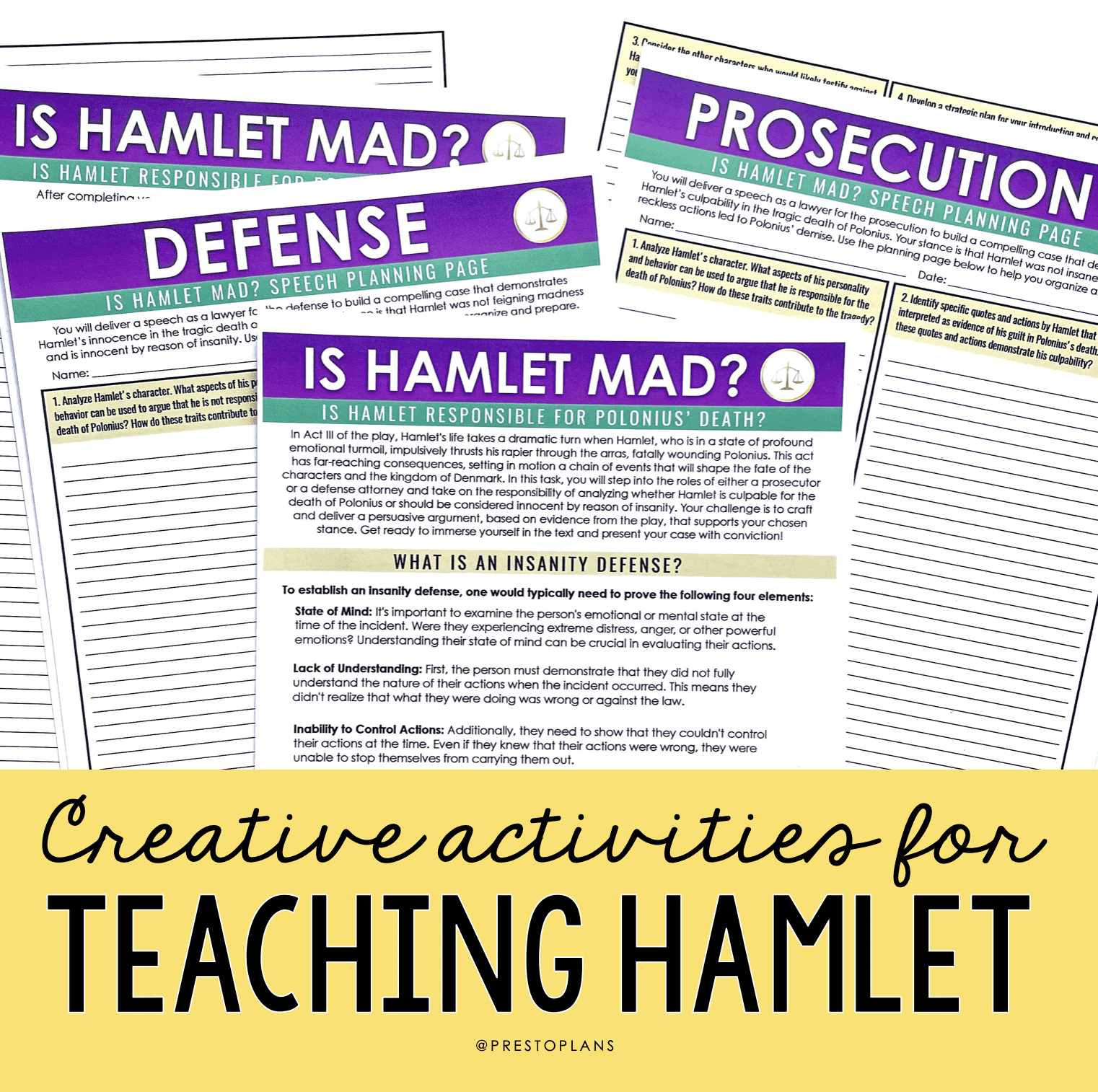
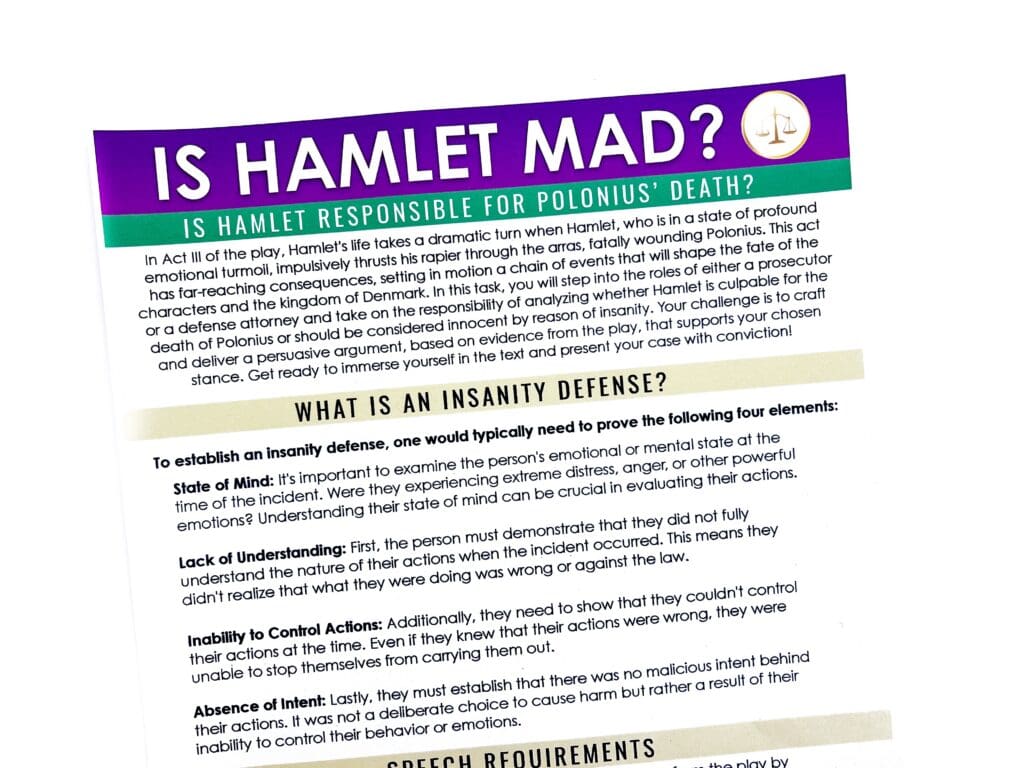
At this point in the play, I find students often benefit from a purposeful, collaborative opportunity to discuss the text with more depth and detail. A whole-class “courtroom” scene offers a unique, memorable way for students to evaluate Hamlet’s actions and determine whether or not he is truly “mad.” For this activity, I like to begin by introducing the case, and then dividing the class into two halves – the prosecution and the defense. The prosecution argues that Hamlet’s actions are not a product of insanity, but recklessness. Meanwhile, the defense contends that Hamlet is innocent by reason of insanity.
From here, each side must develop arguments by analyzing evidence from the play. Graphic organizers help to keep each “side” on track as they consider evidence from the text and determine whether Hamlet should be held responsible for the death of Polonius. From here, students must compose a persuasive speech for a prosecution or defence attorney.
You can choose to have each student write their own speech, or you can have students work in small groups to collaborate on their arguments, with one representative delivering the final speech for each side. Either way, it can be fun and engaging to have a “jury” of students vote for the most convincing, evidence-based argument (and provide a small, inexpensive “prize” to the winning side!).
Act 4: Ophelia Lyrics & Hamlet’s Internet History
In Hamlet’s fourth act, Claudius sends Hamlet to England with a secret plan to have him killed, while Ophelia descends into madness and dies. Laertes returns seeking revenge, and Claudius plots with him to kill Hamlet. When teaching Act 4 of Hamlet, I like to have students explore Shakespeare’s characters through creative and modern text pairings, including contemporary song lyrics. In addition, imagining the modern-day “internet history” of the characters from Hamlet encourages students to synthesize their understanding in a modern and engaging format.
OPHELIA LYRICS ACTIVITY:
For this characterization activity, I like to begin by playing the song “Ophelia” by The Lumineers. I like to play the song twice – the first time, students simply listen, and the second time, students can follow along with a copy of the lyrics. Through guided questions and discussion, they can explore themes like remorse and power, while reflecting on Ophelia’s emotional journey and tragic fate. I find this song also helps students gain a stronger understanding of the key conflicts within the play.
HAMLET INTERNET HISTORY ACTIVITY:
One way to add a modern twist to Shakespeare’s plays is to imagine the characters in contemporary settings. In this task, students select a character from Hamlet (Hamlet, Claudius, Laertes, and Ophelia all work well). Imagining that the character exists in modern-day society, students must use evidence from the text to justify their recent online browsing history. I love this activity because it encourages students to explore Shakespeare’s characters in a fresh, updated way, while still remaining true to the spirit of the original text.
Act 5 and Post-Reading Activities
As Hamlet returns to Denmark in Act 5, he reflects on life and death before dueling Laertes. From here, his plan unravels, leading to the deaths of Gertrude, Laertes, Claudius, and Hamlet himself. I like to wrap up teaching Hamlet with creative activities that help students grapple with the larger themes and concepts that Shakespeare explores within the text.
HAMLET SYMBOLISM ACTIVITY:
Hamlet is packed with symbolism, from Yorick’s skull to Ophelia’s flowers. Working alone or in pairs, students consider the significance of five key symbols from the play. As they record their thoughts on a graphic organizer, they must provide specific, text-based evidence to explain the meaning of each symbol.
THE DENMARK TIMES: NEWSPAPER PROJECT:
For a creative and engaging project to wrap up teaching Hamlet by William Shakespeare, I invite students to pretend they are a writer for “The Danish Times,” a newspaper from the time of Hamlet. As a journalist, they are responsible for creating five unique pieces of content:
- Headline Article
- Obituary
- Special Interview
- Life and Times
- Letter to the Editor
I like to remind students that as a journalist, they must remain impartial and objective (but they can take on the opinions of a private citizen for the “Letter to the Editor”). Graphic organizers, templates, and clear instructions support students with the format of each type of content (and visuals can be added to support and strengthen students’ engagement with the text!).

HAMLET FINAL ESSAY:
Hamlet can provide an excellent springboard for an essay writing unit. If you plan to have students write a final essay about Shakespeare’s classic tragedy, thought-provoking essay prompts can direct students to focus more deeply on a specific aspect of the text. You might like to offer students several options to select from, or you might like to narrow down the choices to suit your specific learning targets.
I hope these creative ideas for teaching Hamlet help you put a fresh twist on your next Shakespeare unit!
Did you know that all these creative activities for teaching Hamlet, plus structured lessons, summary cards, comprehension quizzes, writing tasks, and much, much more, are available in my complete Hamlet Drama Unit? Click below to take a closer look.
Looking for more creative ways to bring Shakespeare’s classics to life in your classroom? Check out these posts!
Teaching Shakespeare in High School: Introducing the Bard
Creative Activities for Teaching Romeo and Juliet by William Shakespeare
Throw Shakespeare a Birthday Party
Search the blog for what you are teaching


GIVEAWAYS
sent straight to your inbox!



share this post